
A Homeowner’s Guide to Wood Fences Styles

Picking the right wood fence is about more than drawing a line around your property; it’s a decision that defines your home's curb appeal, privacy, and security. Whether you're drawn to the timeless charm of a picket fence or the clean lines of a horizontal style, your choice is a practical investment in your outdoor space.
How to Choose the Perfect Wood Fence
Think of your fence as the frame for your home and yard. The right design creates a welcoming vibe, a private backyard oasis, or a secure area for kids and pets. This guide provides actionable steps to help you navigate the options and find the perfect blend of style and function.
The most effective way to start is by defining your fence's primary job. Different wood fences styles are engineered for specific purposes, so clarifying your main goal is the most practical first step.
Key Factors to Consider
Before exploring designs, establish your priorities. Knowing exactly what you need will simplify your choice and ensure your new fence delivers on its promise.
Privacy Needs: Do you need a solid barrier for a completely private sanctuary, or will a semi-private screen that allows for light and airflow suffice?
Security Goals: Is the primary purpose to contain pets and children, or do you require a more substantial structure to act as a deterrent?
Curb Appeal: What aesthetic—classic, rustic, or contemporary—best complements your home’s architecture?
Local Climate: Your fence must be built to withstand the Ottawa–Gatineau region's weather, from heavy snow loads to summer humidity.
Once you have a style in mind, it's helpful to understand what goes into a flawless garden fence installation to see the full picture.
While some designs are purely aesthetic, others have remained popular for their proven functionality. The classic picket fence, for instance, has a design dating to early 20th-century California but remains so effective at defining boundaries that it commands a 41.02% revenue share of the U.S. wood fencing market. You can find more industry data about the wood fencing market on Grand View Research.
Exploring Popular Wood Fence Styles
Choosing the right wood fence style is a practical decision that impacts your daily life. Each style offers a different combination of privacy, security, and aesthetics. To find the right fit, you must understand how each one performs in a real-world setting.
Let's break down the most popular wood fence styles. We'll analyze what makes each one unique, from total backyard seclusion to neighbourly charm, so you can confidently select the option that best meets your needs.
Use this decision tree to narrow down your options based on your primary requirement: privacy, security, or style.
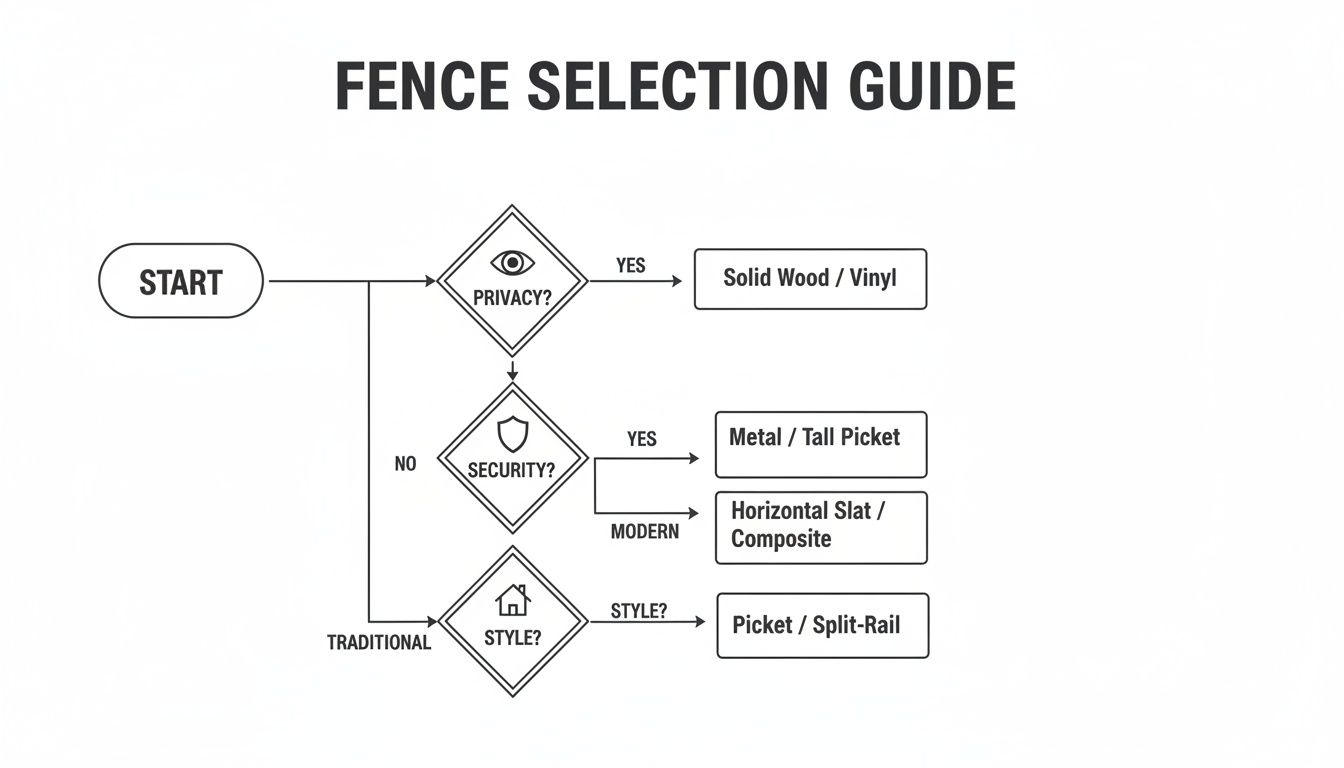
As you can see, your top priority—whether it’s creating a private retreat or a secure boundary—points you directly toward specific fence designs engineered for that purpose.
Styles for Maximum Privacy and Security
When your main goal is to create a secluded backyard, a few key designs are the most effective. They are built to block sightlines and establish a strong perimeter, making them ideal for homes on busy streets, properties with close neighbours, or for enclosing a pool area.
Full Privacy and Board-on-Board Fences
A full privacy fence provides a solid, gap-free barrier. Vertical boards are installed edge-to-edge, creating a seamless wall that completely shields your yard from view. This is the go-to choice for total solitude and security.
The board-on-board fence advances this concept with an overlapping pattern of vertical boards. This construction guarantees complete privacy and adds visual depth. Its key advantage is that as the wood boards naturally shrink over time, no gaps will appear.
Actionable Insight: If your primary objective is a completely private and secure outdoor space, choose a full privacy or board-on-board style for unmatched seclusion and a solid physical barrier.
Stockade Fences
The stockade fence is another excellent choice for privacy and security. It is characterized by pointed-top pickets that fit tightly together. This traditional design offers a rustic look, and its height and solid construction make it a formidable deterrent.
Styles that Balance Privacy and Aesthetics
Not every situation requires a fortress. The goal is often to find a fence that provides substantial privacy without feeling imposing or that looks equally attractive from both sides of the property line.
Shadowbox Fences
Often called the "good neighbour" fence, the shadowbox style is a popular choice for shared property lines. It is built by attaching boards to the rails on alternating sides, creating a design that looks identical from both your yard and your neighbour's.
A shadowbox fence offers significant privacy when viewed directly but allows air and filtered light to pass through at an angle. This makes it a practical choice for windy locations in Ottawa, as it reduces the strain on the fence structure.
Horizontal Fences
For a modern aesthetic, the horizontal fence is a leading choice. The boards run horizontally, a design shift that can make your yard feel wider and more spacious.
You can customize the privacy level by adjusting the spacing between the boards. Install them tightly together for nearly total privacy, or leave small gaps for a stylish, semi-private slatted look.
Styles for Defining Boundaries and Curb Appeal
Sometimes, a fence is more about adding charm or defining a property line than creating privacy. These decorative styles are designed to boost curb appeal and mark boundaries without closing off your yard.
Picket Fences
The picket fence is the classic symbol of a welcoming home. Its evenly spaced vertical boards, often with decorative tops, create a charming boundary without obstructing the view. It is an ideal choice for front yards, gardens, or sectioning off parts of a property.
This style is a market leader for a reason. Picket fences are such a longstanding favourite that they hold a 41.02% revenue share of the U.S. wood fencing market, which was valued at USD 2,274.3 million in 2024. You can dig into more of the numbers in the wood fencing market report from Grand View Research.
Split-Rail Fences
If you want a rustic, open feel, the split-rail fence is a practical option. Comprised of two or three horizontal rails fitted into posts, this style is ideal for large properties or homes aiming for a country aesthetic. It provides minimal privacy or security but is unmatched for marking boundaries in an unobtrusive way.
Choosing Your Wood: Cedar vs. Pressure-Treated Pine
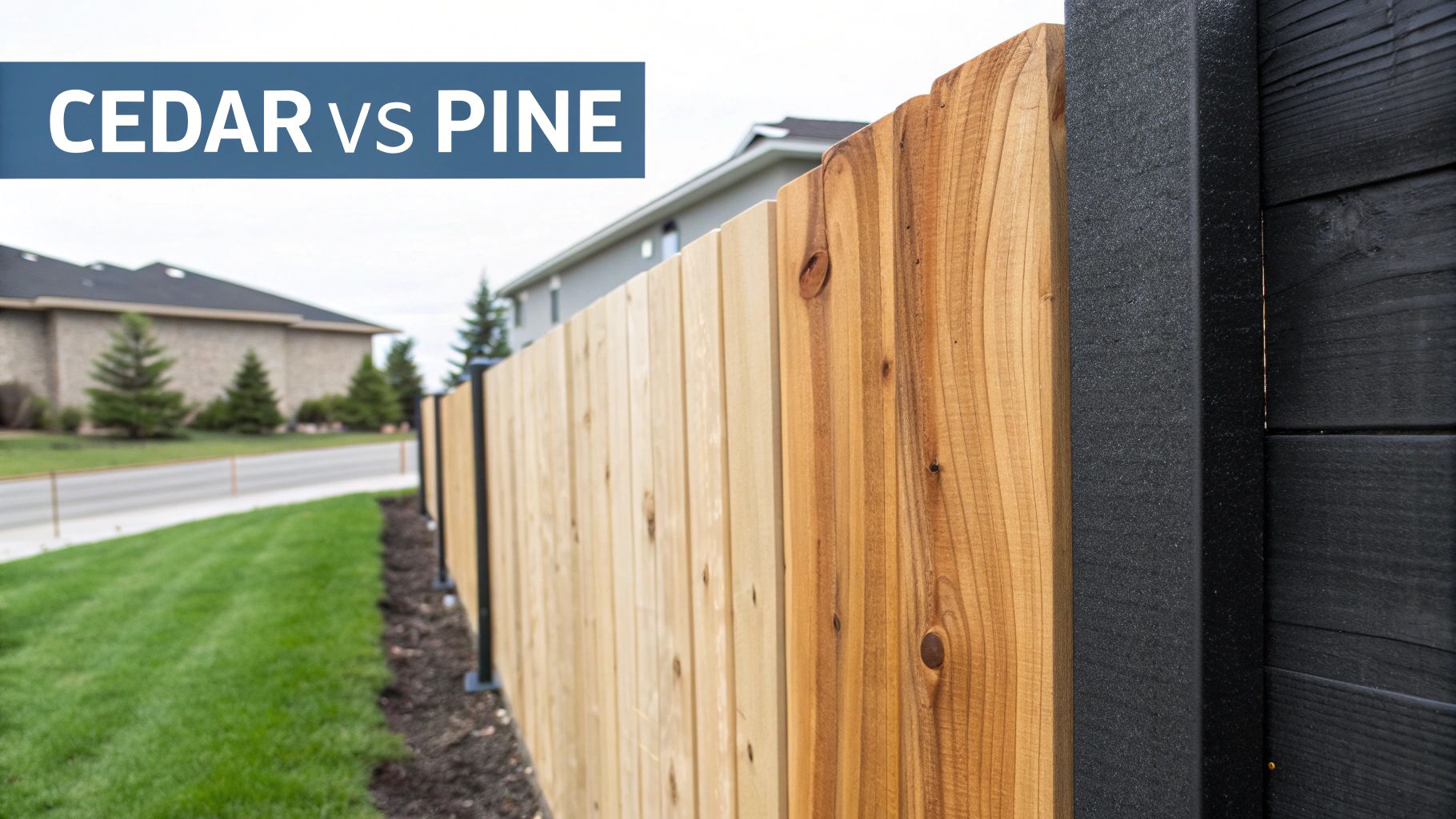
Once you've selected a style, your next critical decision is the wood itself. This choice directly impacts your fence's lifespan, maintenance requirements, and total cost.
In the Ottawa–Gatineau area, the decision typically comes down to two main options: Western Red Cedar and Pressure-Treated (PT) Pine.
Think of this as choosing between two different engines for a car. Both perform the same basic function, but their durability, longevity, and long-term costs differ significantly. Understanding the pros and cons of each is key to making a sound investment.
The Natural Defender: Western Red Cedar
Western Red Cedar is the premium choice for wood fencing. It contains natural oils and tannins that inherently resist rot, decay, and insects without chemical treatments. This natural resilience is why a well-maintained cedar fence can last for decades.
Cedar is also "dimensionally stable," meaning it is far less likely to warp, twist, or shrink as it endures Ottawa's seasonal changes. Its rich, warm colour provides an immediate high-end look.
Longevity: Can last 20-30 years or more with proper maintenance.
Maintenance: Requires staining or sealing every 2-3 years to preserve its colour, but the natural oils provide constant protection.
Cost: Has a higher upfront cost that reflects its natural durability and premium quality.
Actionable Insight: Cedar's natural resistance is a significant advantage in our local climate. It withstands moisture from snow and humidity that can damage other woods, offering long-term durability without chemical aids.
The Budget-Friendly Workhorse: Pressure-Treated Pine
Pressure-Treated (PT) Pine is the practical option for homeowners seeking solid performance on a budget. This wood undergoes a chemical treatment process that makes it resistant to rot, fungus, and insects.
Its protection comes from this treatment, not from the wood's natural properties. PT Pine is a reliable material, but it requires consistent maintenance. Without regular sealing, it is more susceptible to cracking, splitting, and warping.
For additional context on how different woods perform outdoors, reviewing information on timber cladding for exterior walls can offer useful insights.
Material Showdown: Cedar vs. Pressure-Treated Pine
The choice between these materials comes down to balancing your upfront budget with your long-term maintenance commitment. This table provides a clear comparison to guide your decision.
Feature | Western Red Cedar | Pressure-Treated Pine |
|---|---|---|
Durability | Naturally resistant to rot, decay, and insects. | Chemically treated to resist rot and insects. |
Lifespan | 20-30+ years with proper care. | 15-20 years with consistent maintenance. |
Appearance | Rich, reddish-brown tones that age to a silvery grey if left unstained. | Starts with a greenish/brownish tint; weathers to a dull grey. |
Maintenance | Lower maintenance; requires staining/sealing every 2-3 years to preserve colour. | Higher maintenance; requires annual cleaning and sealing to prevent warping and cracking. |
Warping/Cracking | Dimensionally stable; less prone to twisting or shrinking. | More susceptible to warping and splitting if not properly maintained. |
Upfront Cost | Higher initial investment. | More budget-friendly. |
Environmental | Natural and chemical-free. A sustainable choice. | Treated with chemical preservatives. |
Ultimately, both materials can build a strong, functional fence. Cedar offers natural, low-effort durability at a higher initial price, while PT pine provides reliable, budget-friendly performance that requires more hands-on care.
We provide a more detailed analysis in our dedicated guide. You can learn more about cedar vs pressure-treated fences in our article to get all the information you need to make your choice.
Protecting Your Fence from Local Weather
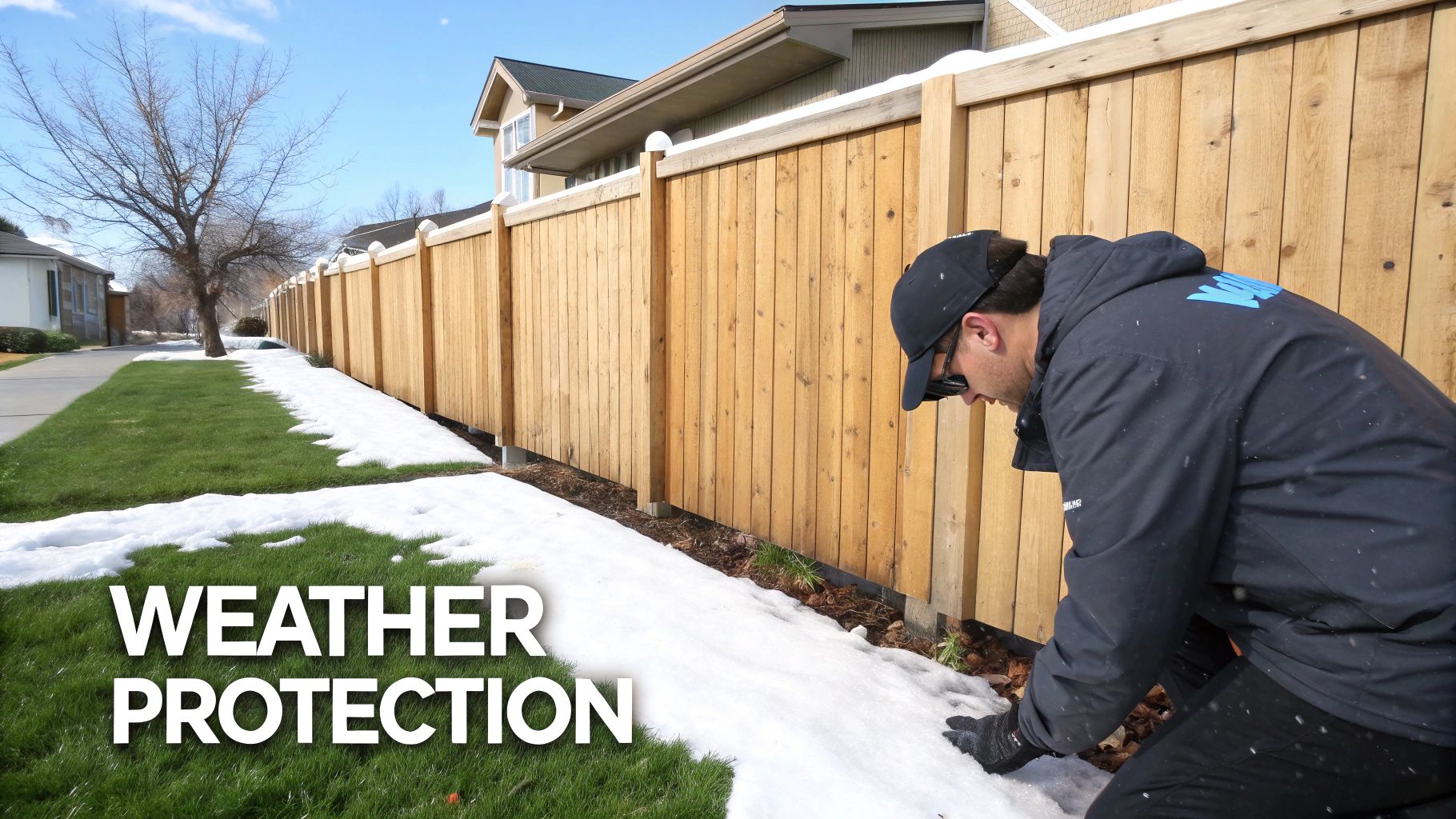
A wood fence is a significant investment; protecting it from the Ottawa–Gatineau region's weather is essential for longevity. Our climate subjects wood to deep freezes, heavy snow, and humid summers, causing it to expand, contract, and absorb moisture. This cycle leads to warping, cracking, and rot.
With the right strategy, you can defend your fence against these elements and maintain its structural integrity for years.
Seasonal Fence Protection Strategies
Proactive maintenance is the key. A simple seasonal routine allows you to address small issues before they become costly repairs, extending the life of your fence.
Autumn Preparation (Stain and Seal)
The single most critical maintenance task is applying a fresh coat of high-quality waterproof sealer or stain in the fall. This creates a protective barrier, forcing rain and melting snow to bead up and roll off instead of soaking into the wood.
Choose the Right Day: Apply sealer on a mild, dry day with low humidity. Ensure a clear forecast for at least 24-48 hours to allow for proper curing.
Clean First: Power wash or scrub the fence to remove dirt, mildew, and old, peeling stain. Allow it to dry completely for one to two days before sealing.
Apply Evenly: Use a sprayer, roller, or brush to apply a consistent coat. Pay special attention to the tops and bottoms of boards, where moisture intrusion is common.
This task is your best defense against moisture damage.
Actionable Insight: A quality sealant acts as a raincoat for your fence. It prevents water penetration, which is the primary cause of rot and the ice damage that occurs during freeze-thaw cycles.
Winter and Spring Inspections
Heavy snow and ice place significant stress on fence posts and panels. As soon as the snow melts, conduct a thorough inspection of your fence.
Here is a checklist of what to look for:
Loose or Heaving Posts: Frost heave can push posts out of the ground. Proper installation below the frost line is critical for prevention, as detailed in our guide to frost depth in Ontario.
Cracked or Split Boards: Identify any boards damaged by the weight of snow drifts or ice.
Loose Nails or Screws: Expansion and contraction of the wood can work fasteners loose.
Addressing these issues in the spring is a quick fix. Tighten loose hardware and replace damaged boards to ensure your fence remains a sturdy, reliable boundary.
Budgeting Your Project and Navigating Regulations
Now, let's cover the practical steps of building your fence: budgeting and regulatory compliance. Getting these right from the start will prevent costly headaches.
The final cost of your fence depends on several factors: total length and height, your choice of material (cedar is more expensive than PT pine), and labour. For a detailed breakdown of how these costs add up, refer to our guide to the price of a wood fence.
Market trends can also affect costs. The growing popularity of vertical board wood fences styles can influence material and labour prices. This trend is part of a U.S. market expected to grow from USD 2,274.3 million in 2024 to USD 2,751.4 million by 2030. You can explore more data on the fence construction industry on IBISWorld.
Understanding Local Bylaws and HOA Rules
Before starting any work, you must research local regulations. Municipalities in the Ottawa–Gatineau area have specific bylaws governing fence construction. Ignoring them can result in fines or an order to remove your new fence.
Actionable Insight: Always verify the specific bylaws for your municipality before beginning construction. Rules in Ottawa, Gatineau, Kanata, and Orléans can differ and are subject to change.
Here is a checklist of what to research:
Height Restrictions: Check for different height limits for front and backyards; front yards are typically more restrictive.
Property Line Setbacks: Determine if your bylaw requires the fence to be set back a certain distance from the property line.
Pool Enclosures: Fences for pools are subject to strict safety regulations regarding height, self-latching gates, and climb-prevention features.
If you live in a neighbourhood with a Homeowner's Association (HOA), you must also comply with their rules on fence styles, materials, and colours. Obtain written approval from your HOA before starting construction.
Your Top Wood Fence Questions, Answered
Choosing the right wood fence involves balancing aesthetics, privacy, budget, and long-term care. To help you make an informed decision, we've answered the most common questions from homeowners in the Ottawa–Gatineau area.
How Long Does a Wood Fence Last?
The lifespan of a wood fence depends on two factors: the wood type and your maintenance routine.
A standard pressure-treated pine fence will last 15-20 years if you consistently stain or seal it every few years to protect it from our climate.
If you invest in Western Red Cedar, you can expect a lifespan of 20-30 years or more. Cedar's natural oils provide inherent resistance to rot and insects. In either case, professional installation with posts set below the frost line is crucial to prevent heaving and ensure the fence remains stable.
What Is the Best Wood Fence Style for Privacy?
For creating a private backyard, a few styles are most effective. Your choice depends on whether you need total seclusion or prefer some airflow.
For complete privacy, select one of these options:
Full Privacy Fence: Vertical boards are fitted tightly to create a solid, gap-free wall.
Board-on-Board Fence: This is our top recommendation for guaranteed privacy. The overlapping boards ensure that even if the wood shrinks over time, no gaps will appear.
The shadowbox fence is an excellent alternative that allows for airflow, which is beneficial in windy areas. Its alternating board design blocks direct sightlines and looks identical from both sides of the property.
Should I DIY or Hire a Professional Installer?
While a DIY installation can seem like a way to save money, building a fence is physically demanding work that requires precision. Mistakes can be costly and time-consuming to fix.
Actionable Insight: A professional installation is an investment in longevity. Experts use specialized equipment to dig post holes correctly and ensure every panel is level and secure, which is critical for surviving Ottawa’s freeze-thaw cycles.
Hiring a professional ensures the job is done correctly, meets local building codes, and typically includes a warranty. This provides peace of mind that your fence will stand strong for years.
How Often Should I Stain or Seal My Fence?
Stain or sealant is the most important protective measure for your fence. For our climate, the recommended practice is to apply a high-quality sealant or stain every 2-3 years. This shields the wood from moisture that causes rot and prevents UV rays from fading and weakening the wood fibres.
Important tip: If you install a new pressure-treated fence, wait a few months for the wood to dry out completely before applying the first coat of sealant.
Ready to bring your vision to life with a fence that perfectly balances style, privacy, and durability? The team at FenceScape specializes in designing and installing beautiful, long-lasting wood fences built to withstand the Ottawa–Gatineau climate. Contact us today for a free, no-obligation estimate and let’s start building the perfect frame for your home.
Comments