
Privacy Fencing for Decks: A Step-by-Step Guide to a Private Outdoor Retreat

Imagine your deck not as an exposed platform, but as a secluded outdoor living room. This guide provides the actionable steps to make that happen with the right privacy fencing for your deck. It's about more than blocking views; it's about making a smart investment to craft a space where you feel completely at ease.
Step 1: Plan Your Private Deck Oasis
Transforming your deck into a private oasis is a strategic upgrade that boosts your home's value and your enjoyment of it. Your goal is to shape a space for relaxing, hosting, or enjoying a quiet morning coffee without feeling exposed. To get there, you need a clear plan that addresses materials, local rules, and a design that complements your home.
This isn't just a niche idea. Homeowners are actively seeking more private outdoor spaces. A 2023 national survey showed that 61% of homeowners who upgraded their fencing did so primarily for privacy. For homeowners in Ontario and Quebec, where decks are a backyard staple, implementing a smart screening solution is a high-value home improvement project.
Action Point: Balance Privacy with Atmosphere
A great privacy fence must feel like an intentional part of your home's design, not a tacked-on afterthought. It directly impacts your backyard's atmosphere. A well-chosen design can strategically hide an unattractive view while framing a beautiful one, turning a simple barrier into a design feature.
Before you build, consider these practical questions:
How will the structure affect sunlight on your deck and garden?
Will a solid wall block a cooling breeze on hot days?
A solid six-foot wall offers total seclusion, but it might cast your garden in permanent shade or create a stagnant, hot-air pocket. Your design goal is to find the functional sweet spot. Beyond the fence itself, actively create the perfect backyard atmosphere with lighting and decor for true relaxation.
Actionable Insight: A well-designed privacy fence does more than just screen your deck; it defines your outdoor living space. Your task is to plan a structure that creates a sanctuary where you can truly unwind.
With this initial planning, you can strike the perfect balance between seclusion, style, and comfort for your Ottawa or Gatineau home.
Step 2: Choose the Right Fence Material for Your Climate
Selecting the right material is the most critical decision you'll make. This choice dictates not just the look, but also the long-term cost, maintenance requirements, and durability against Ottawa–Gatineau's harsh weather. Treat this decision like buying a winter coat—you need something that looks good but also performs reliably through a blizzard.
Your final choice should align with your lifestyle. Ask yourself: Are you a “set it and forget it” type who wants to relax on weekends, not perform maintenance? Or do you appreciate the classic look of natural wood and don't mind the seasonal upkeep? Let's walk through the top contenders to find the right fit for your home.
Before you get lost in material samples, use this flowchart to organize your thinking. It walks you through the first essential steps: defining your privacy needs, researching local rules, and setting a realistic budget.
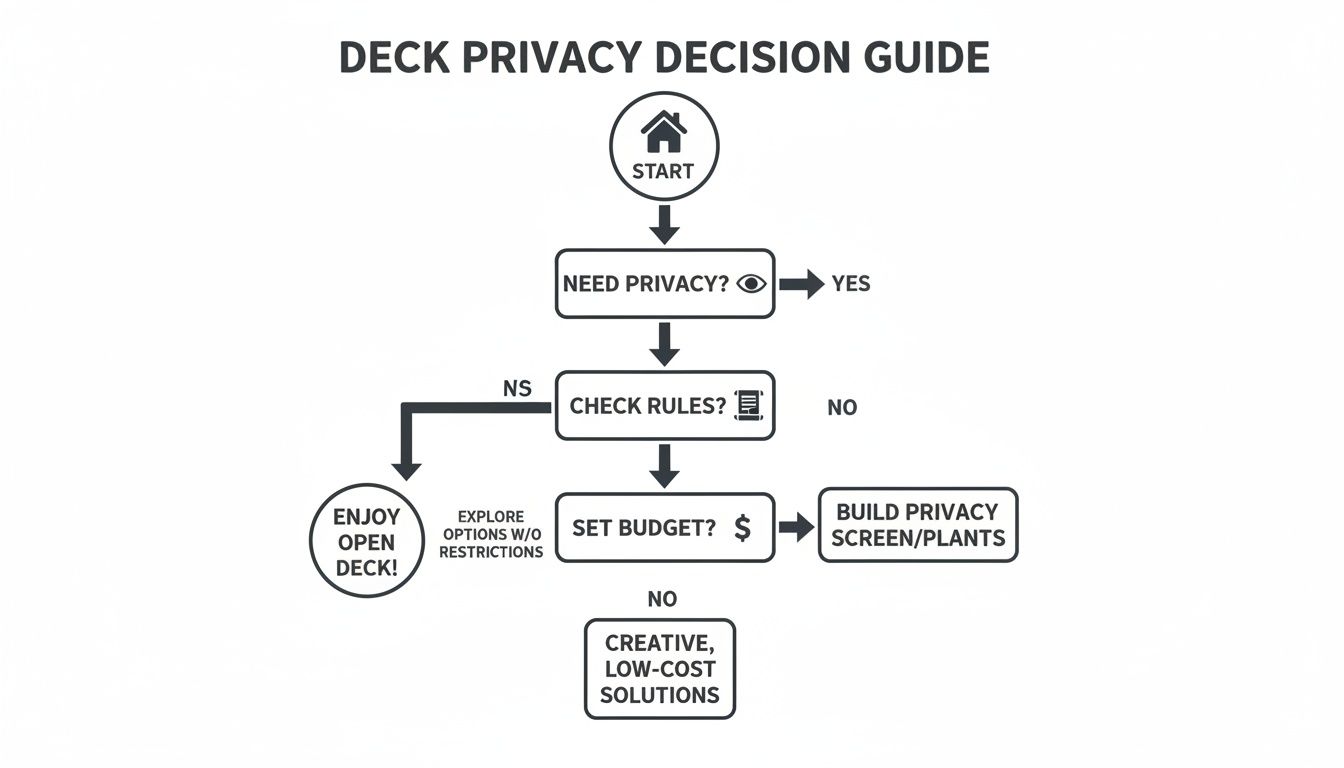
Clarifying these fundamentals first will make choosing a material much simpler. Once you know your goals, limitations, and budget, the best option will become clear.
To help you get started, here is a direct comparison of the most popular materials for deck privacy fences in the Ottawa area.
Deck Privacy Fence Material Comparison
Material | Cost (Initial) | Maintenance Level | Durability in Ottawa Climate | Actionable Tip |
|---|---|---|---|---|
PVC (Vinyl) | Moderate to High | Very Low | Excellent – Won't rot, warp, or crack in freeze-thaw cycles. | Choose PVC if your top priority is a long-lasting, hassle-free solution. |
Wood (Cedar/PT) | Low to Moderate | High | Good – Requires regular staining/sealing to prevent weather damage. | Choose Wood to achieve a classic aesthetic with a customizable finish. |
Hybrid (Metal & Wood/Composite) | Moderate to High | Low to Moderate | Excellent – Steel frame prevents rot and warping of panels. | Choose Hybrid for wood's look combined with metal's structural strength. |
Glass Panels | High | Low | Excellent – Tempered glass is strong and unaffected by moisture. | Choose Glass for modern homes where preserving natural light is essential. |
Metal (Aluminum) | High | Very Low | Excellent – Aluminum is rust-proof and handles snow/ice well. | Choose Metal for maximum security and a sleek, contemporary style. |
This table provides the key details, but your final decision hinges on the trade-offs that matter most to you. Let's dig deeper into each option.
PVC: The Low-Maintenance Champion
For anyone who wants to spend weekends enjoying their deck, not maintaining it, PVC (vinyl) is the answer. Its primary advantage is its exceptional weather resistance. PVC will not rot, warp, or be eaten by insects, making it an ideal material for Ottawa’s humid summers and deep-freeze winters.
To maintain it, simply wash it with soap and water a couple of times a year. While the upfront cost is higher than some wood options, you save significant time and money over the long term by eliminating the need for stain, sealant, or replacement boards. Modern PVC is available in a wide range of colours and textures, including realistic wood-grain finishes.
Actionable Insight: PVC fencing offers a clear trade-off: a higher initial cost for decades of minimal maintenance. View it as an investment in reclaiming your weekends from sanding and staining.
Classic Wood: The Natural Choice
Wood remains popular for its unmatched natural warmth and beauty. Cedar and pressure-treated (PT) pine are the most common choices in our region. Cedar contains natural oils that resist rot and insects, while PT wood is a durable, budget-friendly workhorse.
This classic aesthetic, however, requires a commitment. To protect wood from freeze-thaw cycles and sun damage, you must apply a sealant or stain every two to three years. Neglecting this task will cause the wood to turn grey, weather, and warp. If you enjoy home maintenance and want a customizable look, a wood fence is an excellent choice. To make an informed decision, you can compare top options for your yard in our detailed guide.
Hybrid Fences: The Best of Both Worlds
If you want the look of wood without the worry of rotting posts, a hybrid fence is your solution. These systems use durable steel posts and frames with wood or composite infill panels, combining style with strength.
This design solves the most common failure point of wood fences: posts rotting at ground level. By using steel for the structural elements, you eliminate this vulnerability and significantly extend the fence's lifespan. The result is a fence with the durability needed for our climate and the warm, inviting appearance of wood.
Glass Panels: Modern and Bright
To achieve a sleek, contemporary look without sacrificing sunlight, choose glass panels. For privacy, use frosted or tinted glass to obscure the view while allowing light to filter through. This is an ideal solution for decks that would feel dark or enclosed by a solid fence.
These systems use tempered safety glass engineered to withstand impacts and harsh weather. While glass is a premium material with a higher cost, its unique aesthetic and durability make it a worthwhile investment for the right home. Maintenance is simple: clean it just as you would any window.
Metal Fencing: Durable and Secure
When strength and security are your top priorities, metal is the superior choice. Aluminum is ideal for our climate because it is strong, lightweight, and 100% rust-proof. It typically comes with a durable powder-coated finish that resists chipping and fading from sun and snow.
For privacy, metal fences can be designed with tight picket spacing or combined with other materials, like wood panels, to create a secure and stylish look for your deck.
Step 3: Comply with Local Bylaws and Safety Codes
Before starting any construction, you must understand the local regulations for deck privacy fencing. Complying with Ottawa–Gatineau bylaws is not just about avoiding fines; it’s about ensuring your deck is safe, secure, and legally compliant. These rules are particularly important for elevated structures.
A ground-level fence and a privacy screen on a raised deck are treated differently by the city. A standard six-foot fence along a property line is common. However, attaching that same structure to a second-storey deck could block a neighbour's sunlight or violate height restrictions. This is why specific rules exist for deck railings and attached privacy screens.
Action Point: Know Your Height and Safety Requirements
Memorize this key rule: in Ontario and Quebec, if your deck is more than 24 inches (60 cm) above the ground, your guardrail must be at least 42 inches (107 cm) high. This is the minimum height required to prevent falls.
Your privacy screen is typically built as an extension of this guardrail, meaning its solid base must meet that 42-inch minimum. You may be able to extend higher with a more open design element like a lattice, but total height is also regulated.
Safety codes also mandate that the gap between vertical balusters (upright posts) cannot exceed 4 inches (10 cm) to prevent a small child from slipping through. This rule applies even when building a solid privacy wall, as the underlying support structure must remain compliant.
Actionable Insight: A deck fence is a critical safety barrier. Getting the height and spacing correct is non-negotiable for a safe and approved project. Consult your local municipal building department to confirm requirements before you start.
Action Point: Determine if You Need a Building Permit
Homeowners often get this wrong. The need for a permit is usually triggered by the deck's height and size, not just the fence. In Ottawa, a permit is typically required for any deck that is more than 24 inches above ground or serves as a principal entrance.
Therefore, if you are adding a privacy fence to an existing high deck, a permit was likely required for the original construction. If you are building a new deck and fence that meet these criteria, you will almost certainly need a permit. Skipping this step can result in stop-work orders, fines, or demolition orders.
Your best course of action is to always check with your local municipal office before construction. Understanding the process for hiring Ottawa fence builders can also ensure your contractor handles all permitting correctly.
Broader Safety Considerations
Beyond specific bylaws, there is a growing focus on material safety, particularly fire resistance. Provincial and municipal guidelines are increasingly emphasizing the use of non-combustible materials near homes. While not yet a universal rule, this trend is shaping future building codes. Be prepared for new privacy fences to require a balance between seclusion and higher safety standards.
Step 4: Design for Privacy, Airflow, and Light
An effective privacy fence should make your deck feel like a secluded sanctuary, not a dark, stuffy box. The best designs balance seclusion with airflow and natural light. The goal is not to build an imposing wall but to implement creative screening solutions.
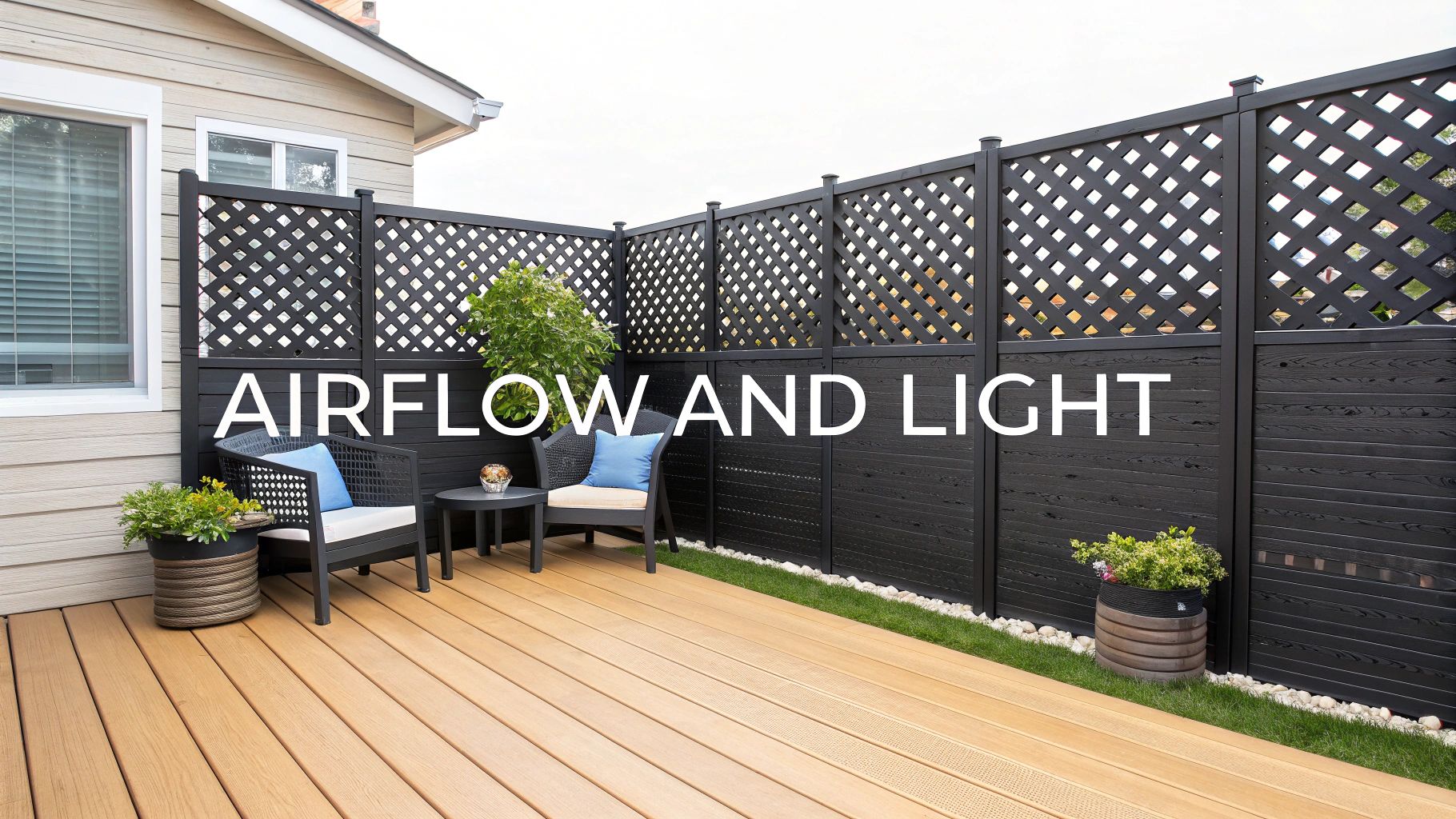
Think of privacy dynamically. Instead of total obstruction, use designs that break up sightlines while allowing air and sun to filter through. This approach ensures your deck remains private, inviting, and comfortable.
Action Point: Incorporate Breeze and Sunshine
A solid privacy wall can have unintended consequences. By blocking airflow, it can turn your deck into a hot spot on summer days. It can also cast your garden—and your neighbour’s—in perpetual shade.
Implement one of these design solutions to avoid this:
Louvered Panels: These function like permanent blinds, angled to block sightlines while permitting airflow. Some advanced systems feature adjustable louvers for full control over privacy and light.
Latticework: A classic for a reason, lattice provides effective screening without feeling heavy. Choose a tighter or wider pattern to control the level of privacy. It also serves as an excellent trellis for climbing plants, creating a living privacy wall.
Decorative Screens: For an artistic touch, use modern metal or composite screens with laser-cut patterns. These panels act as functional art, providing partial screening while casting interesting shadows.
Action Point: Use Strategic Placement for Maximum Impact
You don't always need to enclose the entire deck. First, identify the specific angles you need to block. Is it the view from a neighbour's second-storey window or their adjacent patio?
Actionable Insight: A strategically placed privacy screen is often more effective and less intrusive than a full enclosure. Focus on problem areas to preserve scenic views and maintain an open atmosphere on the rest of your deck.
For example, a single tall panel on one corner may be all you need to shield your seating area. This targeted approach is more cost-effective and visually appealing than a full-perimeter fence, allowing you to maintain a connection to your yard while creating a cozy, private spot. For more budget-friendly ideas, our guide on chain link privacy fence slats offers creative solutions.
Action Point: Use Creative Materials for Light and Privacy
When maximizing light is a priority, use materials that obscure views without blocking the sun. Frosted or textured glass panels are an excellent choice for modern homes. They provide 100% visual privacy while allowing diffused light to pass through, keeping your deck bright and spacious.
To add a distinctive touch, it's worth exploring different specialty glass styles. Translucent polycarbonate panels offer a similar light-filtering effect and are often a more durable and budget-friendly alternative to glass. By combining these materials with a smart layout, you can create a private deck oasis that feels anything but boxed in.
Step 5: Budget for Your Deck Fencing Project
Now, let's talk numbers. Planning your deck's privacy fence requires a clear financial roadmap. Establishing a realistic budget from the start will ensure your project moves from idea to reality without stressful financial surprises.
Treat your budget as the project's foundation. A solid plan will help you choose the right materials and decide whether to DIY or hire a professional, ensuring your investment aligns with your goals and financial means.
Action Point: Estimate Costs Per Linear Foot
Your largest expense will be materials, typically priced per linear foot. This allows for a straightforward ballpark estimate based on your deck's perimeter. Here are the realistic cost ranges you can expect in the Ottawa–Gatineau area:
Pressure-Treated Wood: Your most budget-friendly option at $30 to $65 per linear foot installed. It offers a classic wood look but requires the most maintenance.
Cedar Wood: A higher-quality option, cedar costs $45 to $85 per linear foot. It is valued for its natural beauty and resistance to rot and insects.
PVC (Vinyl): The low-maintenance choice, PVC fencing costs $60 to $120 per linear foot. The higher upfront cost is offset by long-term savings on maintenance.
Hybrid (Metal & Wood/Composite): Combining steel posts with wood or composite panels, these systems range from $75 to $150 per linear foot.
Glass Panels: For a high-end, modern look, budget $150 to $300+ per linear foot for tempered glass panels and aluminum railings.
These figures are a starting point, but other factors will affect the final price.
Action Point: Identify Factors That Influence the Final Price
Several variables can impact your total cost. Understanding these ahead of time will help you create an accurate budget and interpret quotes effectively.
Account for these key factors:
Total Length and Height: A longer, taller fence requires more material and labour, increasing the cost.
Site Complexity: Difficult terrain, such as a steep slope or rocky ground, increases labour costs for setting posts securely.
Old Fence Removal: The demolition and disposal of an existing fence will be an additional charge on your quote.
Gates and Hardware: Each gate adds to the cost, depending on its size, style, and the quality of its hardware.
Permit Fees: If your project requires a building permit, factor the application fees into your budget.
Actionable Insight: A professional contractor's quote should provide a detailed breakdown of all costs. This transparency allows you to see where your money is going and make informed decisions about project priorities.
Action Point: Decide Between DIY vs. Hiring a Professional
The potential for significant labour savings makes a DIY installation seem attractive. While it can be a rewarding project for those with the right skills, you must honestly assess the pros and cons before you begin.
The DIY Approach:
Pros: The primary benefit is saving on labour, which can account for 40-50% of the total cost. You also have full control over the project timeline.
Cons: This requires specialized tools, a significant time commitment, and physical effort. A minor mistake, like improperly set posts, can result in an unstable, unsafe fence that fails prematurely. You are also responsible for obtaining permits and ensuring compliance with local codes.
Hiring a Professional:
Pros: Professionals bring experience, proper tools, and efficiency. They ensure the job is done correctly and quickly. They also manage permits, guarantee code compliance, and typically offer a warranty on their work. This peace of mind is valuable, especially for a structure that must withstand Ottawa winters.
Cons: The main drawback is the higher upfront cost for their labour and expertise.
Ultimately, hiring a professional for privacy fencing for decks is an investment in safety, quality, and a superior finish. Their expertise ensures your fence is not only beautiful but also structurally sound and fully compliant, protecting your home and family for years.
Got Questions About Deck Privacy Fencing?
A plan on paper is one thing; real-world questions are another. Here are answers to the most common questions we hear from Ottawa homeowners to help you move forward with confidence.
Do I need my neighbour’s permission to build a fence?
No, you do not need formal permission if the fence is built entirely on your side of the property line and complies with all local bylaws for height and safety.
However, giving your neighbour a friendly heads-up is a good practice. It's a considerate gesture, especially since construction can be noisy. If you plan to build directly on a shared property line, a formal agreement is necessary.
How do I maintain my deck fence through an Ottawa winter?
Winter preparation depends entirely on your fence material. Follow these steps:
PVC and Aluminum: These materials require no special winter prep. Simply wash them in the spring to remove grime.
Wood: Before the first snowfall, ensure your wood fence has a fresh coat of sealant or stain. This creates a barrier against moisture from snow and ice, preventing rot and warping. In the spring, inspect for any loose boards.
Glass Panels: To prevent scratches, never use a metal shovel to clear snow from the base of the glass. Use a soft brush or a plastic shovel only.
Actionable Insight: The most effective way to minimize winter maintenance is to choose a material rated for the Canadian climate from the start. This will protect your investment and save you work.
Can I add a privacy screen to my existing deck?
Yes, in most cases, you can. The critical factor is whether your current deck structure can support it. The deck and its railings must be strong enough to handle the added weight and increased wind load from a solid screen.
Do not guess. Have a professional assess your deck's structural integrity first. An expert can determine if your deck is up to the task and recommend the best method for securely anchoring the new screen. This ensures your addition is safe, attractive, and looks like it was part of the original design.
Ready to create your own private deck oasis? The expert team at FenceScape specializes in designing and installing beautiful, durable privacy fencing for decks across the Ottawa–Gatineau region. Contact us today for a free, no-obligation estimate and let's build the perfect solution for your home. Learn more at https://www.fencescape.ca.
Comments