
Decorative Fence Toppers That Add Privacy and Style

You've got a solid fence, but the backyard still feels exposed. Perhaps the structure is sound and the posts are straight, yet the view from a neighbouring window comes over the top. Or maybe the front boundary needs more character without turning into a full replacement project. A decorative fence topper can make that small gap feel intentional, adding privacy, filtered light, airflow, or a finished architectural detail.
The important part is choosing the right topper for the fence underneath it. A lightweight lattice panel behaves differently from a solid privacy extension. A post cap may add only a finishing detail, while a trellis can catch wind and support climbing plants. In Ottawa–Gatineau, the choice also has to account for municipal height limits, freeze-thaw cycles, snow, and the strength of existing posts and rails.
A useful starting point is to look at the fence and the property together. If you're planning a front-yard improvement, an AI front yard design tool can help you compare visual directions before you commit to materials. Then the practical questions take over: how much screening do you need, where will the topper sit, and can the existing fence safely support it?
By the end, you'll be able to distinguish a decorative cap from a true privacy extension, compare materials by substrate, check the relevant Ottawa–Gatineau height envelope, and decide whether the installation is suitable for a careful DIY project or deserves professional planning.
What Decorative Fence Toppers Are and How They Work
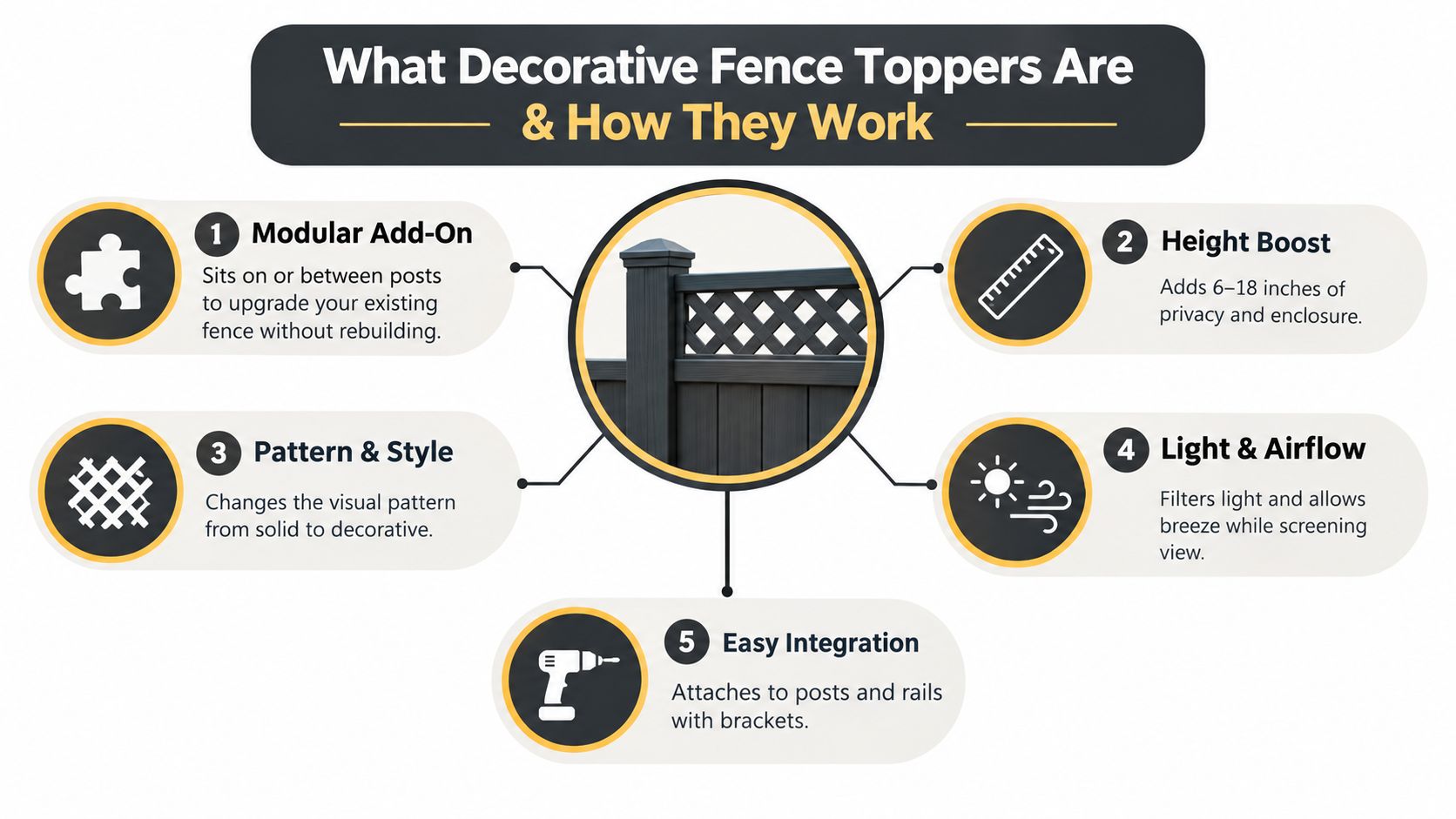
Think of a fence topper as a hat or crown for an existing fence. It sits on top of the fence line or between structural posts, changing the way the boundary looks and performs without necessarily replacing the entire assembly. Depending on its design, it can add visual height, soften a plain horizontal line, filter views, support plants, or finish exposed posts.
The word “topper” covers several different products, so start by identifying what you're adding.
Three common topper arrangements
Post caps sit on individual posts. Pyramid, ball, lantern, and other cap profiles protect the post end while adding a decorative note. Ottawa guidance allows decorative post caps to extend up to 15 centimetres above the maximum fence height, but only on the structural post, as described in Ottawa fence height guidance for post caps.
Infill toppers span between posts. Lattice, slatted panels, scrollwork, and translucent inserts change the fence's upper portion and can provide additional screening.
Integrated extensions combine a taller post, rails, and an upper panel. A trellis or privacy extension installed this way becomes part of the fence assembly, so its height and structural effect need to be assessed as a whole.
The distinction matters because a decorative cap isn't the same as a taller privacy barrier. A cap adds a finishing detail at a post. An infill panel can catch wind, add weight, and alter sightlines across the full fence run.
How toppers change the experience of a yard
An open lattice allows light and air to pass through while breaking up direct views. A tighter slat arrangement gives stronger screening but behaves more like a wind-catching surface. A trellis may add little immediate privacy, yet it can create a garden backdrop as vines grow.
For a practical overview of how lattice extensions attach and function, see FenceScape's guide to lattice fence toppers. Before choosing a style, measure from the outside grade at the fence line and record the existing fence height. That measurement becomes the starting point for checking whether the proposed addition remains within the applicable local envelope.
Popular Types of Decorative Fence Toppers Explained
The right style depends on what you want people to see, what you want them not to see, and how much air should move through the fence. Two toppers can occupy the same space while creating completely different privacy and maintenance outcomes.
Lattice and trellis
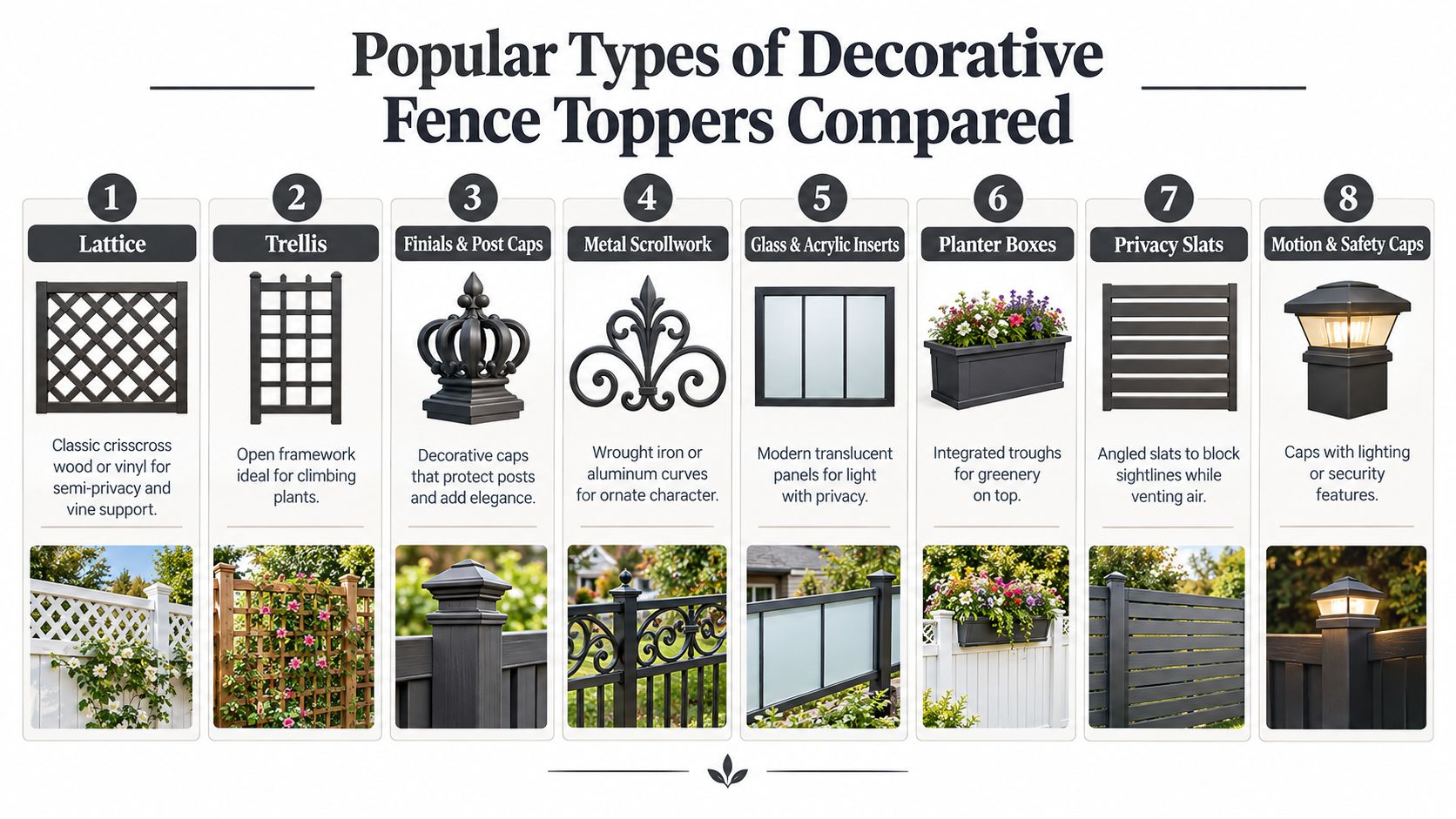
Lattice uses a crisscross pattern that gives a traditional garden appearance. It offers partial screening, breaks up sightlines, and creates a useful framework for climbing plants. Wood and vinyl lattice work well above wood or PVC fences when the supporting posts and rails can handle the added attachment points.
A trellis is usually more open and vertically organised. It reads as a garden feature rather than a privacy wall, making it suitable beside planting beds, patios, or a side boundary where airflow matters. It adds perceived height and structure, but it won't deliver the same immediate screening as a close-pattern panel.
Caps, finials, and metal details
Finials and post caps add personality without filling the entire upper span. A simple pyramid cap can make a modern fence look deliberate, while a rounded cap can soften a traditional picket line. Pointed finials can also make climbing or reaching over a fence more difficult, but they should be evaluated carefully around children, pets, and accessible areas.
Metal scrollwork brings an ornamental effect to wood, masonry, iron, or hybrid fencing. Curved steel or aluminium patterns provide character and visibility, with aluminium generally offering a lighter installation than iron. These toppers suit front boundaries and formal settings where the goal is definition rather than complete seclusion.
Inserts, planters, and functional additions
Glass and acrylic inserts suit contemporary properties. They can preserve daylight and create a cleaner upper line, although the attachment system and panel weight need careful coordination with the fence substrate.
Planter boxes turn the top of a fence into a garden feature. They're attractive beside patios and decks, but wet soil and mature plants add weight, so the supporting structure must be designed for that load rather than treated like a simple ornament.
Privacy slats block more of the view than open lattice while still allowing some ventilation, depending on their angle and spacing. Motion or safety caps combine a decorative post finish with lighting or security functionality, useful where nighttime visibility matters.
Materials Finishes and What Works Best by Fence Type
A topper is only as dependable as the fence carrying it. The same decorative panel can perform well on one substrate and create problems on another if the posts, rails, fasteners, or foundations aren't compatible.
PVC is lightweight and resistant to routine moisture exposure, making it a natural match for vinyl fence systems. It still needs cold-weather consideration. A Canadian regional specification cited by FenceScape lists PVC Izod impact performance at 5.0 ft-lb/in notch at 23°C and 2.0 ft-lb/in notch at 0°C, with tensile strength of 6,500 psi and flexural strength of 11,400 psi. Those figures are provided in FenceScape's vinyl privacy fence style reference, and they support a conservative approach to spacing, attachment, and impact exposure in colder conditions.
Cedar and pressure-treated wood offer warmth and can be stained or painted to coordinate with the home. Wood can also move as moisture levels change, so a rigid topper should have appropriate fastening and movement allowances. A damaged or undersized post shouldn't receive a heavier upper panel because the panel looks attractive.
Ornamental iron and aluminium suit scrollwork and formal designs. Iron brings visual weight and may need protective finishing, while aluminium can reduce the load on posts. Glass and acrylic preserve light but demand precise hardware, edge protection, and a structure capable of keeping panels stable through seasonal movement.
Topper Material | Best Fence Substrate | Durability and Maintenance Notes |
|---|---|---|
PVC or vinyl | PVC, vinyl, and compatible hybrid systems | Low routine maintenance, but cold-weather impact and attachment details matter. |
Cedar | Wood and compatible hybrid fences | Warm appearance, with periodic finish care and inspection for movement or moisture exposure. |
Pressure-treated wood | Pressure-treated wood and robust hybrid systems | Practical for matching an existing wood fence, but it needs sound posts, appropriate fasteners, and finish maintenance. |
Aluminium | Ornamental iron, wood, PVC, and hybrid systems | Lightweight option for decorative patterns, with finish quality and galvanic compatibility worth checking. |
Iron or steel | Ornamental iron and reinforced wood or masonry systems | Strong visual presence, but protective coatings and corrosion checks are part of ownership. |
Glass or acrylic | Glass, masonry, and engineered contemporary systems | Clean modern appearance, with careful attention to hardware, impact exposure, cleaning, and panel support. |
Composite | Compatible composite, wood, and hybrid systems | Can provide a consistent contemporary finish, but the product's weight and fastening system must match the posts and rails. |
For a broader look at decorative panel combinations, FenceScape's decorative fence panel guide is a useful design reference. The practical rule is simple: choose the topper and the substrate as one system, not as two unrelated purchases.
Installation and Compliance Considerations for Ottawa–Gatineau
The visual design should come after the height and structure check. Start at the property line and divide the fence into front, side, and rear yard zones, because the permitted envelope can change across the same lot.
In the Ottawa region, a local fencing by-law summary lists front-yard fences at 1.07 m, or 3 ft 6 in, back-yard fences at 2.5 m, or 8 ft 2 in, and side-yard fences at 1.9 m, or 6 ft 2 in. The same summary identifies pool fence minimums of 1.5 m, or 4 ft 11 in, for single-detached and semi-detached homes, and 1.8 m, or 5 ft 11 in, for townhouses and apartments. Check the Ottawa fencing by-law quick reference before treating a decorative addition as exempt.
Other Ottawa-facing guidance describes residential front-yard fences as capped at 1 m, with side and rear fences reaching 2.13 m. Because local references can present rules by context and fence category, use the applicable City by-law for your exact property rather than relying on a general design article. The City of Ottawa fence by-law is the appropriate place to verify the current requirement.
Measure the complete assembly
Measure from grade outside the enclosure, not from the top of a deck, a raised garden bed, or an interior surface. Ottawa construction fencing guidance requires a minimum height of 1.8 m when a site is within 3.0 m of a public pathway or public gathering area. For a residential building of no more than three storeys located more than 3.0 m from an adjacent public walkway, the minimum is 1.2 m, according to the Ottawa construction fencing information sheet.
A topper shouldn't reduce a required screen or push the total assembly beyond a permitted limit. Post caps receive limited treatment as an add-on, but a spanning lattice or slatted extension generally changes the effective fence height and load.
Check the structure before the finish
Ask an installer to inspect:
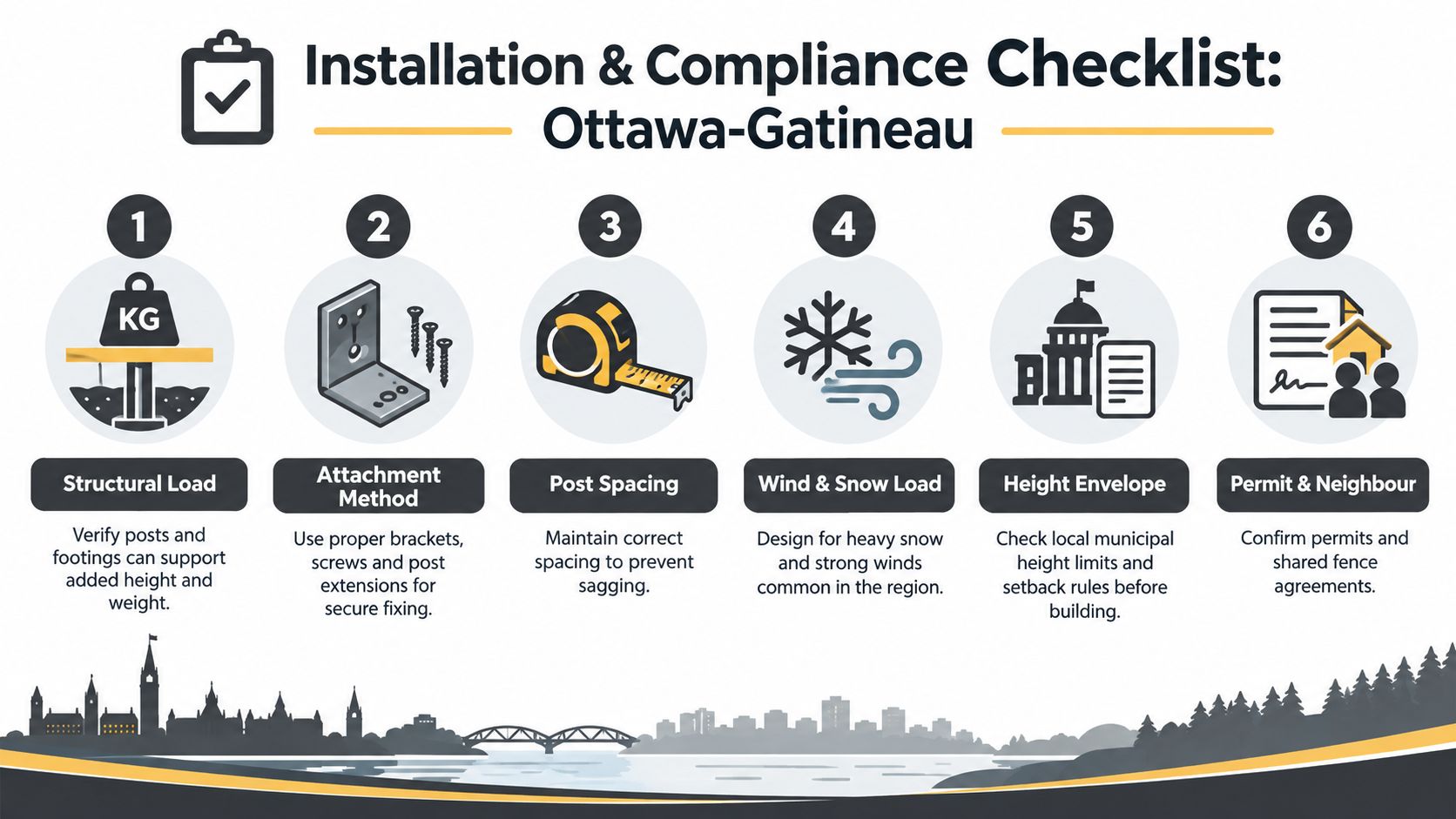
Post condition: Look for leaning, rot, cracking, loose concrete, or movement at the base.
Rail capacity: Confirm rails and brackets can accept the topper without sagging or twisting.
Attachment method: Use compatible screws, brackets, post extensions, and corrosion-resistant hardware.
Spacing: Keep spans controlled so a lattice, planter, or rigid insert doesn't flex under wind.
Seasonal exposure: Account for snow accumulation, freeze-thaw movement, and wind pressure on a more solid upper panel.
Neighbour and permit issues: Confirm ownership of a shared fence and any municipal or pool-related requirements before ordering materials.
Practical rule: Treat a solid topper as a new load-bearing surface, not as decoration.
Québec projects also fall within the provincial building-regulations framework. The RBQ identifies the Québec Construction Code as the National Building Code of Canada 2015 with Québec amendments, and its Safety Code and Construction Code information is relevant when structural or safety expectations apply. For a practical discussion of height extensions, use FenceScape's fence height extension guide, then verify the final design against the municipality and property conditions.
Costs Maintenance Longevity and DIY Versus Professional Help
The price of a topper depends less on the word “decorative” than on the work hidden behind it. Material, panel size, finish, post extensions, access, hardware, and the condition of the existing fence all affect the project. A small run of post caps is a very different job from a continuous privacy extension that requires new supports and careful height verification.
Maintenance follows the material. PVC usually needs routine washing and inspection of brackets. Cedar and pressure-treated wood may need cleaning, stain, or paint maintenance, along with checks for splitting and movement. Metal deserves attention to coating damage and corrosion, while glass and acrylic require regular cleaning and careful inspection around fasteners and edges.
A straightforward DIY test
DIY may be reasonable when the topper is light, the posts are sound, the fence line is accessible, and the attachment instructions are clear. It becomes a higher-risk job when the fence is shared, the upper panel is solid, the ground is uneven, the posts are old, or the installation affects a pool enclosure or regulated sightline.
Situation | DIY may fit | Professional help is wiser |
|---|---|---|
Existing fence | Straight, stable, recently inspected | Leaning, cracked, loose, or deteriorated |
Topper design | Small caps or lightweight open lattice | Solid panels, planters, glass, or heavy metal |
Compliance | Clearly outside regulated areas | Front yard, corner lot, pool, walkway, or shared boundary |
Tools and skills | You have appropriate drills, levels, fasteners, and safe access | You need post extensions, new footings, or structural repairs |
Long-term protection | You can maintain and inspect it | You want coordinated workmanship, warranty clarity, and post-install support |
Professional installation can also simplify design coordination. FenceScape offers planning, in-house crews, material supply, and post-install support for Ottawa–Gatineau projects, with financing options for Ontario and Québec customers and neighbourhood group discounts available for qualifying organised projects. Those options don't remove the need for by-law checking, but they can make a compliant, durable installation easier to manage from measurement through final walkthrough.
Choosing Your Look and Taking the Next Step with FenceScape
Start with the outcome, not the catalogue. A tight urban lot may benefit from a modest, well-spaced privacy extension that blocks the most direct sightline without creating a heavy wall. A front yard often suits post caps, low open lattice, or metal scrollwork that adds character while preserving visibility. A pool enclosure needs a design that supports the required safety height and doesn't compromise the barrier. A commercial perimeter may call for restrained metal detailing, lighting, or a clean topper that reinforces the property's appearance.
Keep the proportions close to the fence beneath them. A delicate topper can look lost on a broad privacy fence, while an oversized planter or solid insert can overwhelm a lighter structure. Match the finish to the home, repeat an existing colour where possible, and stand at the property line to test sightlines before approving the design.
FenceScape can prepare a design, provide a free estimate, coordinate installation with in-house crews, and support the project through precise completion and post-install service. If you're comparing options for a wood, PVC, hybrid, ornamental iron, chain link, or glass fence, the next useful step is a site-specific review rather than another generic style gallery.
Visit FenceScape to request a free estimate and discuss a decorative fence topper that matches your fence substrate, Ottawa–Gatineau height requirements, and seasonal exposure. Their team can help you move from a privacy, curb-appeal, pool, or commercial goal to a practical design and coordinated installation.
Comments