
Chain Link Fencing Posts Guide for Ottawa Homes

You've tightened the chain link fabric, levelled the top rail, and watched the gate swing properly. Then Ottawa's winter arrives. In spring, one post leans, another has lifted, and the gate no longer meets the latch. The fabric usually isn't the first failure. The posts are.
For a durable fence in Ottawa–Gatineau, choose the posts as a structural system. Their position, diameter, wall thickness, coating, spacing, and embedment depth determine how well the fence handles fabric tension, wind, gates, moisture, and frost movement. A useful starting point is to treat the fabric as the skin and the posts as the skeleton. If the skeleton is weak, a better-looking skin won't correct the problem.
Why Chain Link Fencing Posts Matter More Than the Fabric
A chain link fence looks like a continuous wall, but its loads travel through a small number of structural points. The woven fabric fills the space between posts. The line posts keep that fabric upright, while the end, corner, and gate posts absorb the pull created when the fabric is stretched and attached.
Think of a camping tent. The fabric creates the enclosure, but the poles and pegs determine whether it stands in wind. Chain link works in much the same way. A post that's too light can flex; a footing that's too shallow can move; a gate post that isn't reinforced can rotate under repeated opening and closing.
Practical rule: If you're deciding where to spend attention, start with the posts and footings before comparing small differences in fabric appearance.
A common backyard problem begins subtly. One end post shifts after freeze-thaw cycles, so the fabric loses tension. The top rail follows the movement, the line posts no longer form a straight run, and the gate begins to drag. By the time the sag is obvious, correcting the fabric alone won't solve the underlying movement.
The Canadian federal chain-link standard limits line-post spacing to no more than 3.1 m, or 10 ft, centre-to-centre between terminal posts, and requires posts to be installed vertically. That spacing controls the number of supports along a run and helps maintain fabric tension, alignment, and long-term performance. The standard remains present in updated 2024/2025 federal collections, which shows its continuing relevance to Canadian work. (Canadian General Standards Board chain-link fencing standard)
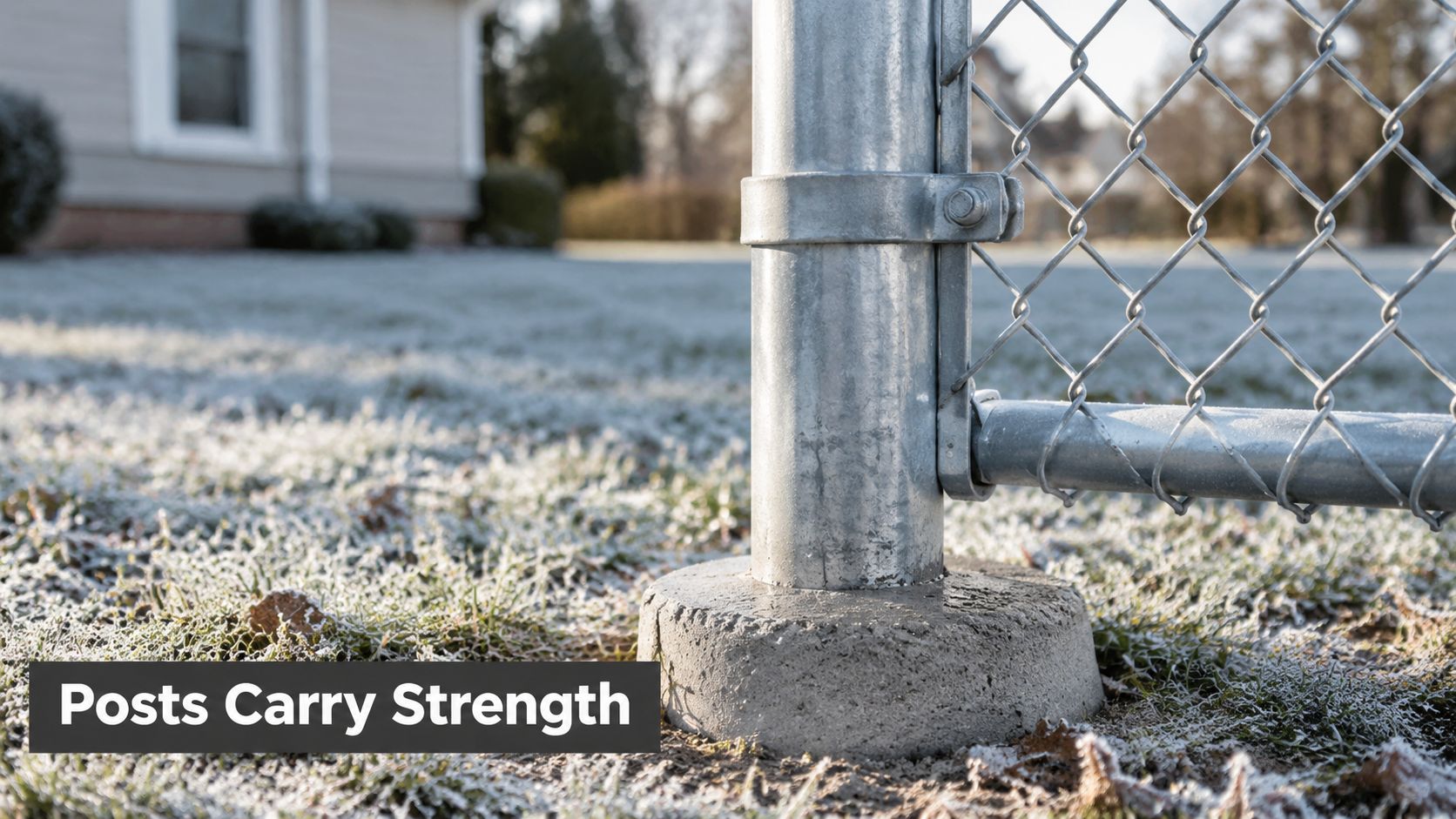
This guide follows the practical order I use when discussing a fence with a first-time homeowner: identify each post's job, choose a material and coating suited to exposure, size the framework, then set it below frost penetration with enough concrete to resist movement. That sequence matters because a post can be well coated and still fail if it's in the wrong position or set too shallow.
Understanding Line Terminal Corner and Gate Posts
Chain link fencing posts fall into four main families. They look similar at a glance, but they don't carry the same forces.
Line posts hold the run together
Line posts sit between the structural ends of a fence. Their job is to support the fabric and top rail, preserve height, and keep the run aligned. They're repeated along the straight sections, so their spacing affects both material quantities and the fabric's ability to remain taut.
Terminal posts finish a run at an end, change in direction, or gate opening. The fabric pulls against these posts, making them anchors rather than simple intermediate supports. They need more steel than line posts because the load concentrates at the attachment and tension hardware.
Corner posts do the same anchoring work while also changing the direction of the fence. A corner can receive tension from two fence runs, so it must resist forces from different angles. That's why a corner isn't just a line post placed at a bend.
Gate posts support hinges, latches, and the weight and movement of the gate itself. Each swing transfers force into the post and footing. A gate can look perfectly aligned on installation day and still sag later if its posts rotate in the soil.
A suspension bridge offers a useful comparison. The deck is comparable to the fence fabric, while the towers and anchors carry the major forces. Line posts support the span, but terminal and corner posts control the tension. Gate posts are specialised towers with moving loads attached.
Match each post to its position
Canadian public-sector specifications show why the four positions shouldn't be treated as interchangeable. One Alberta standard specifies line posts at 60.3 mm outside diameter with a 3.91 mm wall thickness, while terminal posts are 88.9 mm outside diameter with a 5.49 mm wall thickness. The same source describes heavier framework for demanding fence heights and conditions. (Alberta chain-link fence specification)
Another way specifications distinguish posts is by mass. One Canadian municipal specification identifies line posts at about 5.43 kg per linear metre and terminal posts at about 11.28 kg per linear metre. These differences reflect the job each component performs, not a cosmetic preference.
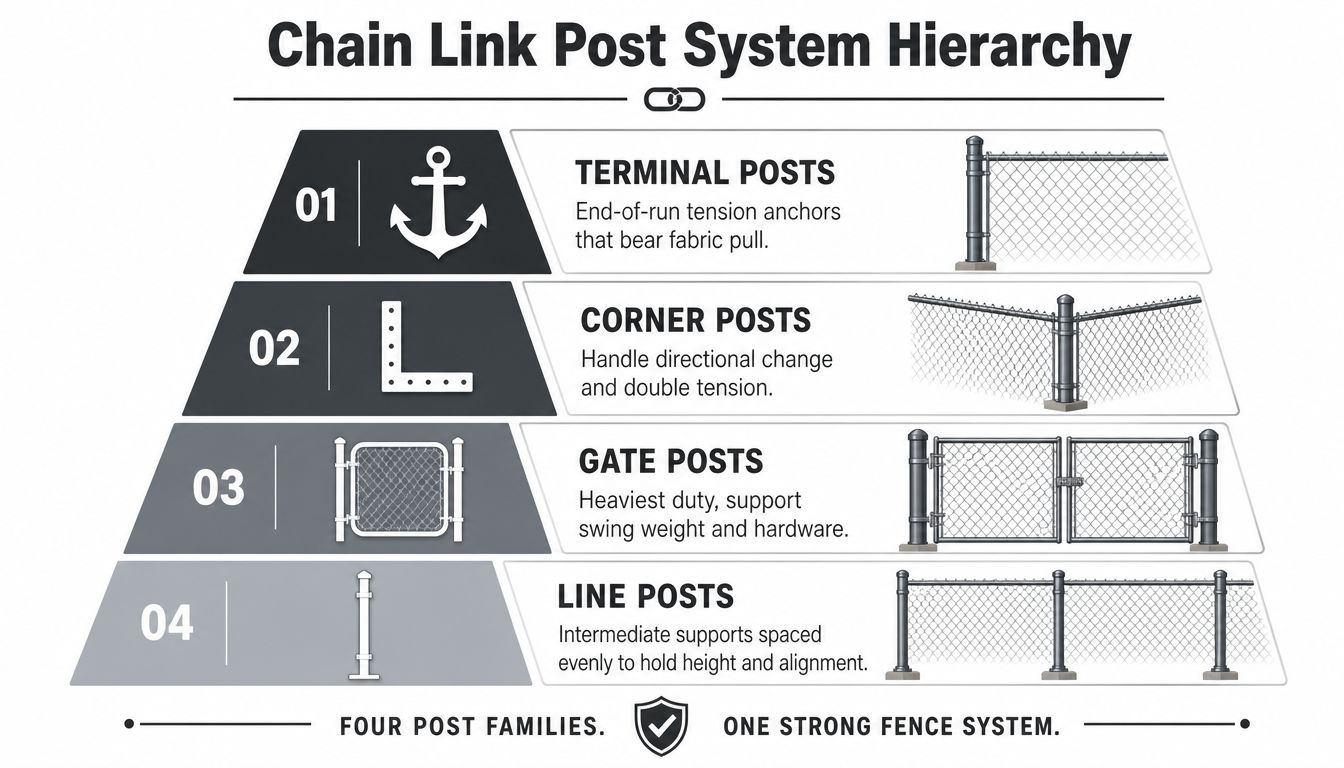
Before finalising a fence layout, mark every end, corner, and gate opening. If the property boundary or existing improvements make the layout difficult to interpret, practical residential survey process advice can help you understand when a surveyor's input is appropriate. The important fencing lesson is simple: count post roles first, then count repeated line supports.
Materials Coatings and Corrosion Protection for Canadian Winters
Post material answers one question, while coating answers another. Steel provides the structural strength. The coating helps protect that steel from moisture, salt, and damage at vulnerable areas such as cut ends, welds, and the ground line.
Galvanized steel
Galvanized steel uses a zinc coating to slow corrosion. It's a practical choice for many residential yards because it offers a familiar balance of structural performance and maintenance needs. In Ottawa–Gatineau, however, exposure matters. A post beside a salted driveway or road faces a harsher environment than one in a sheltered backyard.
Inspect the ground-line area during maintenance. Water that remains against the post, damaged coating, and soil that holds moisture can all shorten service life. The post cap and fittings matter too, because a strong tube paired with poorly matched hardware can create weak points.
Vinyl-coated steel
Vinyl-coated steel adds a PVC layer over the steel. Homeowners often choose it for a darker, more unified appearance when the fabric and framework are both black or another selected colour. The additional layer creates another barrier against moisture, but installers still need to avoid cutting, scraping, or forcing components together in a way that damages the coating.
Vinyl coating isn't a substitute for correct drainage or footing design. A protected post can still shift if frost lifts the concrete, and a well-set post can still corrode if fittings don't match the coating system.
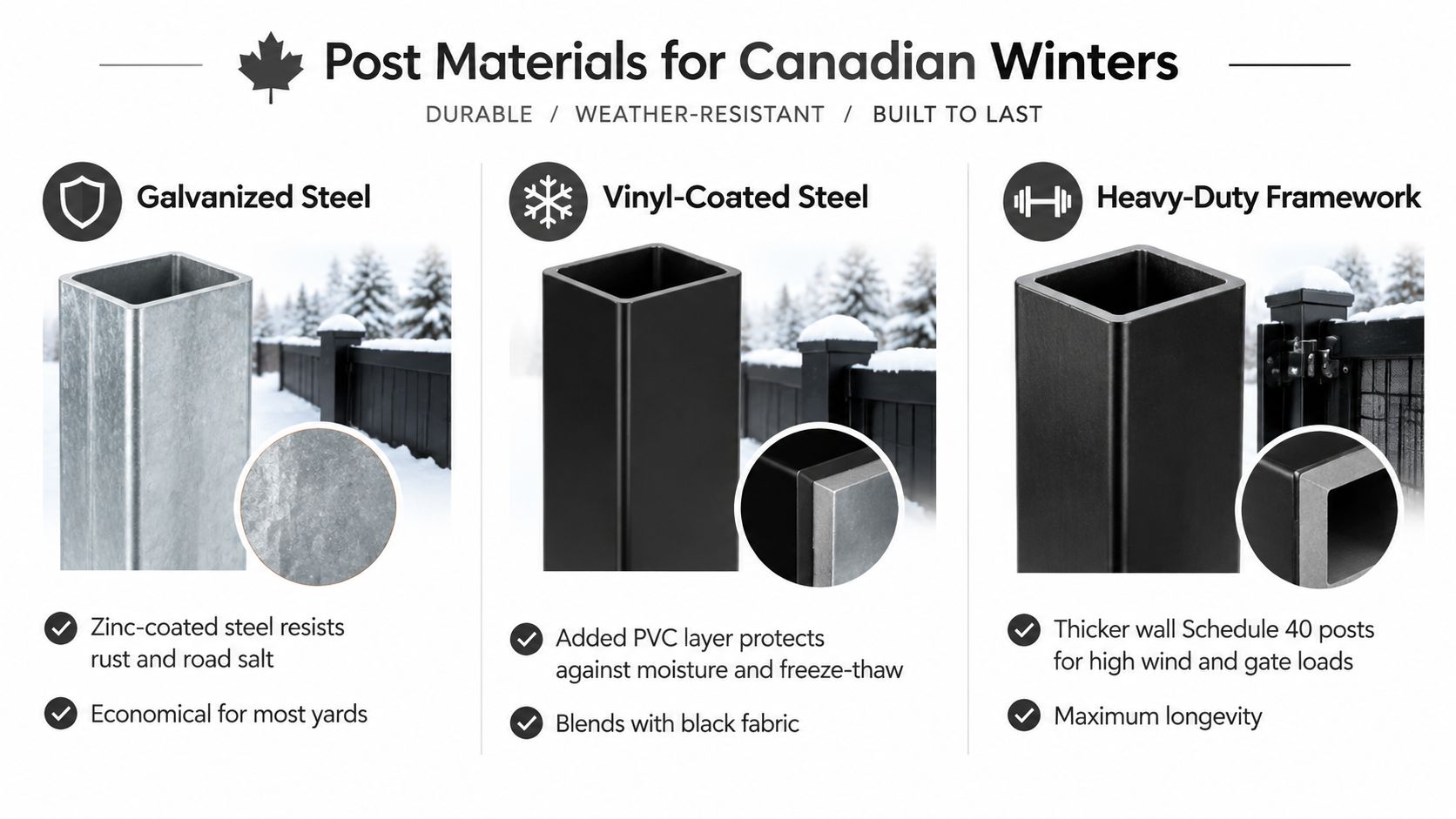
Heavy-duty framework
Heavy-duty framework becomes more relevant when a fence has substantial gate loads, difficult wind exposure, added privacy screening, or a security function. Federal security guidance recommends larger post diameters for higher-security applications, including 73 mm O.D. line posts, 114 mm O.D. strain posts, and 150 mm O.D. corner posts. That's a clear move beyond minimal residential framing. (Federal security fencing considerations guide)
Alberta and Ontario public specifications also point toward galvanized pipe or roll-formed steel shapes compatible with national standards. In practice, that means you shouldn't choose a post in isolation. Confirm that the fabric, rails, caps, tension hardware, fittings, and coating system are designed to work together.
For more detail on vulnerable areas and maintenance, use this guide to chain link fence rust. The right choice depends on exposure and risk. Standard galvanized steel may suit a sheltered yard, while a gate, privacy screen, or security perimeter can justify heavier framework and more thorough corrosion protection.
Sizing Spacing and Height Guidelines That Keep Fences Straight
Post sizing should follow the fence's loads, not just the fabric's height. A taller fence presents more surface area to wind, and a gate concentrates repeated movement at its hinges and latch. Terminal posts also carry the fabric tension that line posts mainly distribute.
The Alberta specification gives a useful example of how positions differ. It calls for 60.3 mm outside diameter line posts with 3.91 mm wall thickness and 88.9 mm outside diameter terminal posts with 5.49 mm wall thickness. For heavier or more security-sensitive applications, the federal guidance cited earlier recommends larger framework still. (Alberta chain-link fence specification)
Use spacing as a planning constraint
The federal Canadian standard sets the maximum line-post spacing at 3.1 m, or 10 ft, centre-to-centre, measured between terminal posts, with posts installed vertically. Don't treat that as a suggestion to stretch every run to the limit without considering the fence height, terrain, wind, fabric, and gate arrangement. Use it as a maximum constraint when estimating the number of line posts. (Canadian General Standards Board chain-link fencing standard)
Regina's municipal specification provides a concrete example of how hole dimensions change with fence height:
Fence height | Line post hole | Terminal post hole |
|---|---|---|
1200 mm fabric | 200 mm diameter, 1200 mm deep | 300 mm diameter, 1500 mm deep |
1800 mm fabric | 250 mm diameter, 1200 mm deep | 350 mm diameter, 1500 mm deep |
The table shows two principles clearly. Taller fabric can require larger holes, and terminal posts require both greater diameter and greater depth than line posts. That extra concrete and embedment helps resist the concentrated pull at the ends and corners.
Before buying materials, draw the fence line and label each end, corner, and gate. Then estimate the straight-run supports without exceeding the maximum spacing. A line-post spacing guide can help you check the layout before you order posts, rails, and fittings.
Frost Proof Embedment Depths and Concrete in Ottawa Gatineau Soils
In Ottawa–Gatineau, a post footing has to deal with water changing state in the surrounding soil. If the footing sits within the zone affected by frost penetration, seasonal movement can lift or rotate it. The result may be a leaning line, a twisted corner, or a gate that stops lining up with its latch.
Canadian installation requirements state that footing depth must be no less than the average annual frost penetration. Corner posts should be set 300 mm, or 12 in., deeper than line posts. Those requirements recognise that terminal and corner posts carry higher tension and need more resistance to uplift and rotation. (Canadian General Standards Board chain-link fencing standard)
Dig for the soil, not just the visible fence
Ontario-oriented guidance commonly places post embedment below the frost line, with a typical minimum range of 36 to 48 inches, or 3 to 4 feet, for the region. It also notes that corner and gate posts may need embedment as deep as 1.8 metres when their loading and stability demands are greater. (Ontario chain-link fence installation guidance)
Regina's specification gives a useful construction reference: for 1200 mm fabric, line-post holes are 200 mm in diameter and 1200 mm deep, while terminal-post holes are 300 mm in diameter and 1500 mm deep. For 1800 mm fabric, the listed holes are 250 mm by 1200 mm for line posts and 350 mm by 1500 mm for terminal posts. (Regina chain-link fence specification)
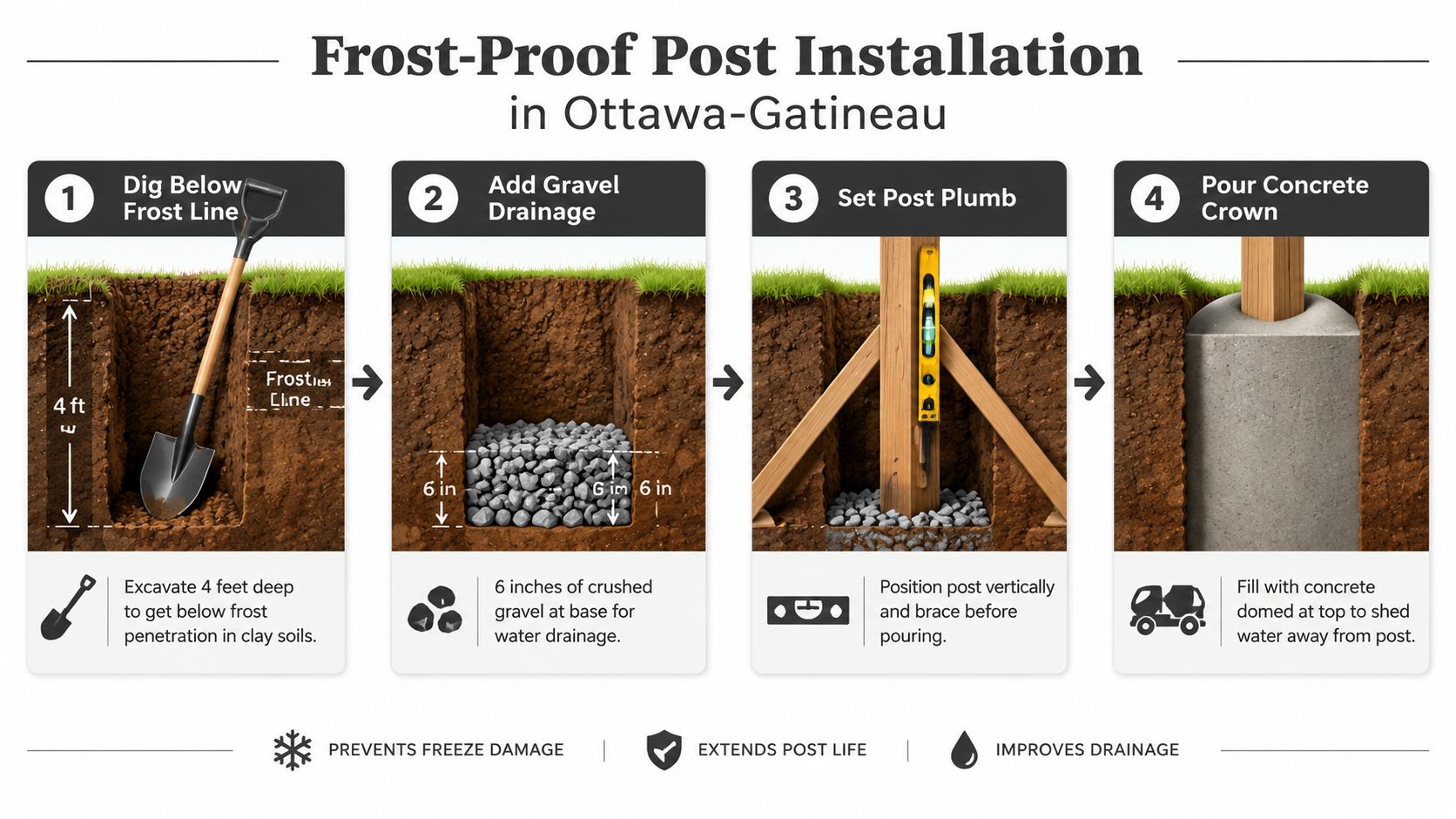
Set the footing in a controlled sequence
Mark the layout and locate utilities. Confirm property lines, gate openings, corners, and underground services before excavation.
Dig to the required depth and diameter. Don't reduce a terminal hole to save concrete. That's where the fabric and gate loads concentrate.
Manage water at the base. A compacted drainage layer can reduce standing water, but it doesn't replace frost-appropriate depth.
Set the post vertically. Check two faces with a level, then brace the post so it can't move while concrete is placed.
Crown the concrete away from the steel. A sloped or domed finish helps direct surface water away from the post rather than trapping it at the ground line.
Allow the footing to stabilise before tensioning. Stretching fabric against immature concrete can move a carefully aligned post.
The same principle applies to other post-supported outdoor structures. For a useful comparison of anchoring logic, review this explanation of Guelph deck post anchor installation. For fence-specific layout and setting guidance, use placing fence posts as a practical preparation reference.
A short visual walkthrough can also help you understand the order of operations before you dig:
Installation Overview Tools Costs and When to Hire a Contractor
A permanent chain link installation is manageable for an experienced DIY homeowner with a straight, accessible run. The difficulty rises quickly when the job includes hard soil, slopes, multiple corners, a heavy gate, or a pool enclosure. Post holes are where the project becomes physical, precise, and expensive to redo.
Organise the work around the structure
The usual sequence is straightforward, but each stage depends on the one before it:
Layout: Mark the fence line, terminal positions, corners, gates, and property boundaries.
Excavation: Dig each hole to its required depth and diameter, then prepare the base.
Post setting: Install terminal posts first, check plumb and alignment, then place line posts.
Framework: Add rails, caps, brace fittings, tension hardware, and gate hardware.
Fabric: Attach and stretch the fabric only after the posts and concrete are stable.
Inspection: Walk the full run, check straightness, tension, gate movement, and exposed hardware.
Useful equipment includes a post-hole digger or auger, shovel, wheelbarrow, tape measure, string line, stakes, level, pliers, wire cutters, wrenches, braces, and a fabric-stretching tool such as a come-along. An auger can save labour in suitable soil, but it doesn't remove the need to verify hole diameter, depth, alignment, and underground utilities.
Budget reality: The cheapest installation is the one you won't have to excavate and reset after the first difficult winter.
Choose DIY or a crew deliberately
DIY makes sense when the run is short and straight, access is good, the soil is workable, and you're comfortable setting posts vertically and maintaining accurate spacing. A contractor becomes more sensible when the fence includes several structural changes, a slope, a large gate, rocky ground, or a pool enclosure where local requirements deserve careful attention.
Before committing, check Ottawa or Gatineau requirements for fence placement, height, property boundaries, and pool fencing. A property survey may be appropriate where the boundary isn't clear. Call the relevant utility-locating service before digging, and plan for spoil removal, concrete handling, equipment access, and cleanup.
For contractors comparing the wider fencing trade, fencing work for contractors offers useful context on the type of work involved. For maintenance, inspect posts and fittings periodically, remove vegetation, clean exposed surfaces with mild soap and water, and address damaged coating or loose hardware before moisture creates a larger problem.
FenceScape is one Ottawa–Gatineau option for a turnkey chain link project, including planning, installation, and post-install support. A professional assessment is especially useful when the project combines gates, corners, slopes, security requirements, or pool enclosure considerations.
Choosing the Right Posts for a Fence That Lasts
The right post choice starts with four questions: How tall is the fence? Where are the gates and corners? How exposed is the site? How much winter movement can the footing tolerate? Those questions lead to a better specification than asking for galvanized posts.
For a sheltered residential run, a compatible galvanized framework may provide the practical balance you need. If the property borders a salted driveway, receives strong wind, includes privacy screening, or has a gate that will be used constantly, upgrade the framework and pay closer attention to terminal footing design. Higher-security work may call for the larger diameters identified in federal security guidance rather than minimal residential framing. (Federal security fencing considerations guide)
Use this decision filter
Straight run: Measure the line and plan line posts without exceeding the Canadian maximum spacing.
Ends and corners: Identify every terminal position before ordering materials.
Gate openings: Select posts and footings for hinge, latch, and swing loads, not just fabric height.
Winter exposure: Confirm that the footing depth meets frost requirements and that corners receive the required additional embedment.
Corrosion risk: Choose galvanized or vinyl-coated components according to moisture, salt, appearance, and maintenance expectations.
Security demand: Ask whether heavier diameters, thicker walls, or stronger fittings are appropriate for the risk.
Don't mix components casually. A line post, terminal post, top rail, cap, tension fitting, and gate assembly need compatible dimensions and coatings. A mismatch can create installation trouble even when each individual part appears suitable.
If you're doing the work yourself, prepare a scaled sketch, verify the boundary, mark utilities, and calculate post positions before purchasing concrete. If the site has difficult soil, several corners, a slope, a gate, or a pool enclosure, request a site assessment instead of treating the job as a simple fabric installation. Long-term value comes from reducing movement and rework, not from choosing the lightest tube on the shelf.
FenceScape helps Ottawa–Gatineau homeowners plan and install chain link fencing with posts, gates, coatings, spacing, and frost-aware footings selected for the site. Visit FenceScape to discuss your layout, request a tailored estimate, and choose between material planning and a complete installation.
Comments