
A Complete Guide to Privacy Fences for Decks
- Eric Lafleche
- Jan 6
- 16 min read

Picture this: you step out onto your deck, coffee in hand, and sink into a chair, completely hidden away from the prying eyes of neighbours or passersby. That's what a good privacy fence can do. It's not just about putting up a barrier; it's about carving out a genuine outdoor living room where you can relax, host friends, and feel totally at ease.
Creating Your Private Deck Oasis
Think of a privacy fence as the walls of your outdoor room. It's the single most important element that transforms an open, exposed platform into a secluded retreat. Here in the Ottawa-Gatineau area, your action plan is to find a solution that stands up to our wild weather while also giving you the solitude you're after. The real goal is to build a backyard escape that's beautiful, functional, and perfectly private.
A well-designed fence extends your home's living space into the outdoors. It creates a sense of security and enclosure that makes your deck feel like a natural extension of your house—a huge plus in many of our neighbourhoods where homes are built close together.
Why Privacy on Your Deck Matters
Blocking sightlines is the obvious win, but a thoughtfully planned fence brings so much more to the table. These are practical benefits that can genuinely improve how you use and enjoy your home.
Noise Reduction: To make your deck more peaceful, install a solid fence. It acts as a sound buffer, dampening the noise from traffic, lawnmowers, and general neighbourhood chatter.
Defined Space: Use a fence to put a clear border around your outdoor living area. This gives it a real sense of purpose and makes it feel like its own distinct zone.
Increased Safety: If you have kids or pets, a secure fence turns your deck into a safe, contained play area. This is a practical step to increase peace of mind.
Enhanced Ambiance: Select a fence material and design that acts as a stunning architectural feature, complementing your home’s style and boosting its curb appeal.
To create a private deck, you must take control of your environment. Decide how much of the outside world you let in, turning a simple structure into a personal haven for relaxation and connection.
To really nail the transformation of your deck into a private sanctuary, it's worth looking at all kinds of outdoor enclosure options. For instance, a complete guide to installing and choosing screens for patios provides excellent tips on selection and installation that often translate well to deck privacy projects.
Choosing the Right Fence Material
Picking the right material for your deck’s privacy fence is the most critical decision you'll make. It’s about more than just looks; it shapes the durability, maintenance, and long-term cost of your new outdoor space. To make the right choice, compare materials like you would a winter coat in Ottawa—some look fantastic but require constant care, while others are built to handle a blizzard without a second thought.
Your material choice is the foundation for everything else. It determines how well your fence will stand up to our heavy snow loads and biting winds, how many summer weekends you’ll spend on upkeep, and the real value it adds to your home. Let's dig into the top contenders that make sense for our climate.
This visual gives you a great starting point for thinking through the whole process, from materials and design to deciding whether to build it yourself.
As you can see, creating that perfect private deck is all about finding the right balance between how it looks, how it performs, and how it gets built.
PVC (Vinyl): The Modern Workhorse
If your goal is to "set it and forget it," then choose PVC fencing. It’s engineered to withstand everything our region can throw at it—from deep winter freezes to humid summer days—without warping, cracking, or rotting. It just works.
This resilience means you get your weekends back. A vinyl fence will never need to be painted, stained, or sealed. To maintain it, all you need is a quick wash with soap and water now and then to keep it looking new for decades.
The long-term value is undeniable. A recent analysis found that a well-installed vinyl privacy fence can last 30+ years, compared to the typical 15–20 year lifespan for wood. Over time, that adds up to serious savings.
Wood: The Timeless Classic
You just can't beat the warm, natural charm of a wood fence. Materials like cedar and pressure-treated pine have a way of blending right into your backyard, complementing the garden and landscape with their rich colours and textures.
Cedar is a fantastic choice, famous for its natural ability to resist rot and insects. For a more budget-friendly option, select pressure-treated pine, which is chemically treated to fend off decay, making it another durable and extremely popular pick for deck privacy fences.
Of course, this natural beauty requires action. To keep a wood fence looking its best and standing strong, you must clean and re-stain or seal it every few years. If you skip this upkeep, our harsh weather will take its toll, leading to fading, warping, and a much shorter lifespan. For a deeper dive, check out our detailed comparison of wood fence types for your yard.
Choosing wood is an investment in that classic look. Be prepared to provide the care it needs, and in return, it will provide a beautiful, organic backdrop for your outdoor life.
Comparing Deck Fence Materials
To make your decision easier, here’s a quick-reference table that breaks down the key differences between the most popular materials for Ottawa-Gatineau homeowners. Use it to compare your options side-by-side.
Material | Upfront Cost | Maintenance Level | Typical Lifespan | Best For |
|---|---|---|---|---|
PVC (Vinyl) | Moderate to High | Very Low | 30+ Years | Homeowners wanting maximum durability with minimal upkeep. |
Cedar | High | Moderate | 20-25 Years | Those who love natural wood's look and are prepared for regular maintenance. |
Pressure-Treated Pine | Low to Moderate | Moderate to High | 15-20 Years | Budget-conscious projects where the classic wood aesthetic is a must. |
Hybrid (Steel Frame) | High | Low | 25+ Years | Homeowners who want ultimate strength combined with the look of wood or PVC. |
Ultimately, the best material is the one that fits your budget, your lifestyle, and the look you want to achieve for your backyard retreat.
Hybrid Fences: The Best of Both Worlds
If you can’t decide between the iron-clad strength of steel and the look of wood or vinyl, a hybrid fence is your answer. This smart approach uses a super-strong, galvanized steel frame for the posts and rails, creating a rigid backbone that will absolutely never sag, twist, or warp.
You then get to choose the infill panels—either classic wood boards or modern PVC slats. This combination gives you incredible strength and longevity while letting you nail the exact style you’re going for. It's the practical solution if you refuse to compromise on either durability or design.
Popular Designs for Deck Privacy Fences
A great privacy fence is so much more than a barrier; it's a key piece of your deck's design that really sets the mood for your entire outdoor space. To choose the right style, you need to balance how much seclusion you want with the overall look you want to achieve. Let's move beyond a simple wall of boards and explore some popular designs that do a beautiful job of blending function with flair.
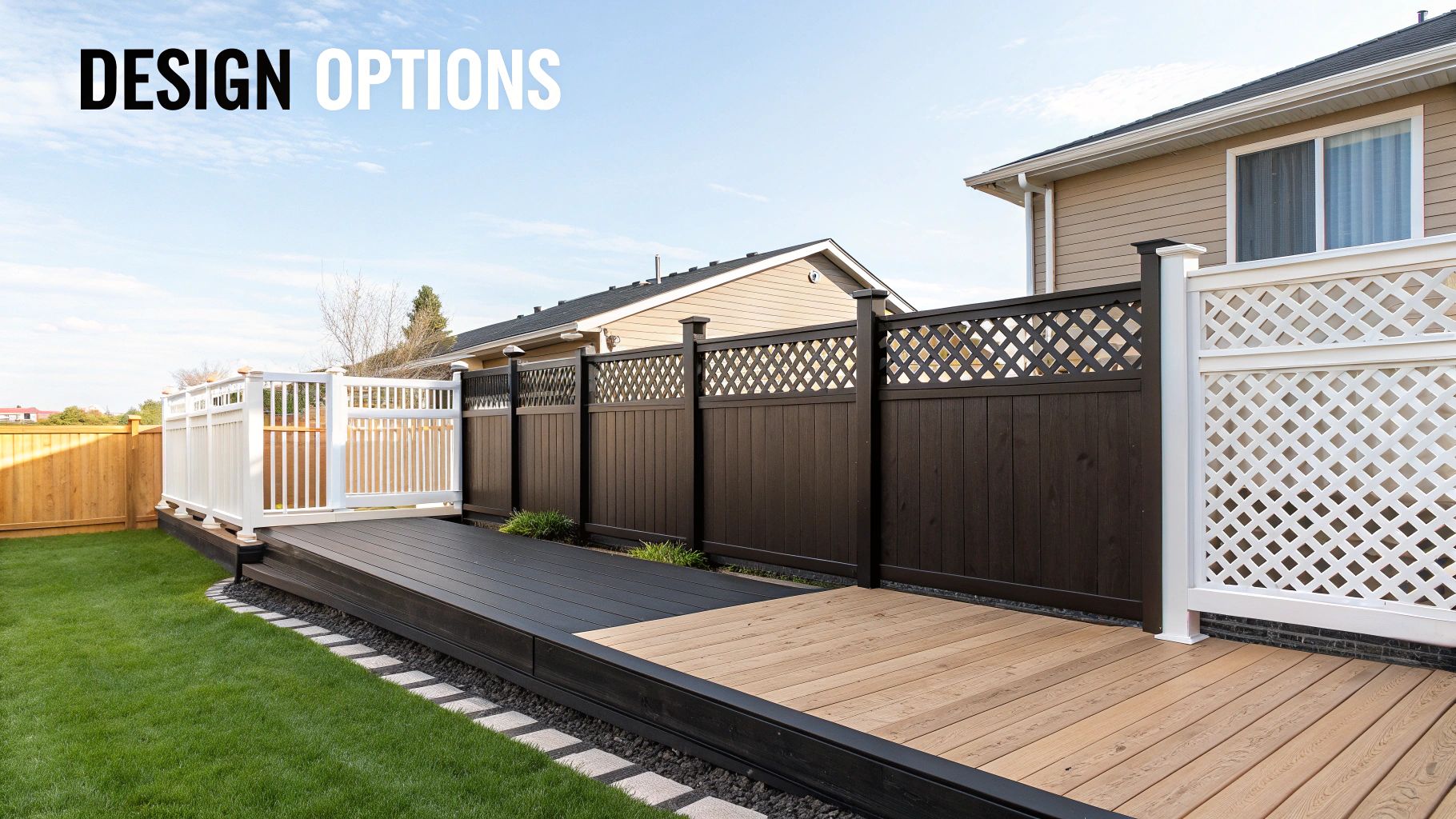
The design you land on will completely shape the atmosphere on your deck. A solid-panel fence can make it feel like an intimate, private outdoor room, while a style with more open elements helps keep that airy, spacious vibe.
Full Solid-Panel Fences
If total seclusion is your main objective, the full solid-panel design is the most effective choice. This style uses vertical or horizontal boards fitted tightly together, creating a seamless, opaque barrier. When you build this, you are effectively creating an outdoor wall that’s highly efficient at blocking both sightlines and a surprising amount of sound.
This approach is perfect for decks close to neighbours or busy streets, giving you an unmatched sense of solitude. You can dine, relax, or entertain without feeling like you’re on display for the whole neighbourhood.
Demand for these robust privacy fences for decks is on the rise, especially in denser parts of Ottawa and Gatineau. Recent data shows that 68% of homeowners are now prioritizing this type of fencing to deal with living closer to their neighbours. A taller, 6-foot solid-panel design can also cut street noise by up to 50%, which makes a huge difference. If you're interested in the numbers, you can read the full research on modern fencing demands.
Lattice-Top Fences
What if you want privacy but don't want to feel completely boxed in? The lattice-top design is an elegant compromise. This classic style gives you a solid panel on the bottom half for privacy where you need it most—at eye level—while topping it off with a decorative lattice section.
That open weave of the lattice lets sunlight and breezes filter through, which is a practical way to keep the space from feeling too dark or stuffy. It also adds a touch of classic charm and breaks up the visual monotony of a solid wall.
A lattice-top fence is a functional way to balance the need for seclusion with a desire for openness. It’s a design that says "private, but not uninviting," making it a perfect fit for sociable homeowners who still value their personal space.
This style works beautifully with both wood and vinyl. Choose a cedar fence with a lattice top for a warm, traditional feel, or a white PVC version for a crisp, contemporary look that’s also incredibly low-maintenance.
Horizontal Board Fences
For a distinctly modern and sophisticated look, a horizontal board fence is a fantastic choice. Instead of the usual vertical pickets, this design lays the boards horizontally, creating long, clean lines that draw your eye outward.
It’s a clever visual trick that can make a deck or yard feel wider and more expansive. To get the exact level of privacy you want, customize the spacing between the boards:
Zero-Gap: Fit boards flush against each other for complete privacy and a sleek, minimalist look.
Narrow-Gap: Leave a small, quarter-inch gap between boards to add texture and shadow lines without giving up much privacy.
Wide-Gap: Create larger gaps for a semi-private screen that defines the space while still feeling open and airy.
Horizontal fences are a real statement piece, perfect for complementing contemporary homes and modern landscaping.
Shadowbox Fences
A shadowbox fence is the ultimate "good neighbour" fence because it looks exactly the same from both sides. It's built by attaching boards to the central rails in an alternating pattern—one on your side, the next on your neighbour’s, and so on.
This staggered layout gives you solid privacy when you look at it from an angle, but it still allows for good airflow and a bit of light to pass through when viewed straight on. It’s a brilliant way to build a shared boundary that both you and your neighbour can appreciate, completely avoiding the old "who gets the good side?" argument.
Right, let's talk about the less glamorous but absolutely critical side of building your deck's privacy fence: the rules. Before you even think about digging that first post hole, you need to get familiar with the local bylaws.
Building a privacy fence isn't just about picking nice materials; it's also about staying on the right side of the law. Here in the Ottawa-Gatineau region, fence bylaws exist for good reason—they ensure safety, keep things fair between neighbours, and maintain a bit of community harmony. To avoid headaches, fines, or being forced to tear your new fence down, you must follow them.
Think of the bylaws as the official playbook for your project. They spell out exactly how high your fence can be, where it can sit on your property, and what extra rules kick in if you've got a pool. Getting this right from the very start will save you a world of trouble and make sure your new fence is an asset, not a liability.
Key Height Restrictions in Ottawa and Gatineau
One of the first questions to answer is, "How high can I actually build this thing?" The answer gets a bit tricky when a deck is part of the equation. Both Ottawa and Gatineau have clear height limits you need to respect.
In Ottawa, the standard rule for a backyard fence is a maximum height of 2.1 metres (that’s 7 feet). But here's the crucial detail: that measurement is taken from the ground up. If you build your privacy screen directly on your raised deck, the city looks at the total height from the ground to the very top of your new fence. This can easily push you over the limit, so you must plan carefully.
Gatineau has its own set of specific height regulations as well. The smartest action is to check the latest municipal bylaws yourself or, even better, work with a local contractor who lives and breathes these rules. They'll know the ins and outs of building on elevated decks and can make sure your design is compliant from day one.
Navigating local fence bylaws isn't optional. It’s the single most important step to protect your investment, avoid fights with your neighbours, and ensure your project goes off without a hitch. A compliant fence is a worry-free fence.
Understanding Property Lines and Setbacks
Where you build is just as important as how high you build. Your fence needs to be built entirely on your property. Even a few inches over the line can spark a nasty and expensive dispute with your neighbour. The only way to be 10-0% sure where your property begins and ends is with a property survey. If you don't have one, it's a worthwhile investment.
You might also hear the term "setback" thrown around. This is simply the minimum distance your fence must be from the property line. While most backyard fences can go right on the line, some areas or corner lots have setback rules you must follow to ensure clear sightlines for traffic and pedestrians.
Special Rules for Pools and Division Fences
If your deck is anywhere near a pool, you must adhere to a whole other level of safety rules. Pool enclosure bylaws are incredibly strict for obvious reasons, and they have very specific demands for any fence or gate that's part of the enclosure.
Minimum Height: Fences around a pool typically need to be at least 1.5 metres (5 feet) tall to prevent children from gaining unsupervised access.
Gate Requirements: Any gate in the fence must be self-closing and self-latching. The latch itself has to be high enough that a small child can't reach it.
Climbability: Your fence design can't have horizontal boards or other features that a child could use as a makeshift ladder to climb over.
Lastly, if your fence is going right on the property line, it’s legally considered a division fence (or boundary fence). Both Ontario and Quebec have laws that detail how neighbours should share the cost and maintenance. The best action is always to have a friendly chat with your neighbour before you start. Getting on the same page about the design, cost, and timeline from the beginning is the key to a smooth project and a happy neighbourhood.
How to Budget for Your Deck Fence
Let's get right to the numbers. Figuring out a budget for a new deck privacy fence can feel daunting, but it’s the most important first step you can take. A solid financial plan is your best tool for choosing the right materials and design without getting hit with unexpected costs down the road.
The final price isn't just one big number; it’s a mix of a few key things. Once you get a handle on these variables, you’ll be in the driver’s seat, ready to make a smart investment in your backyard oasis.
Breaking Down the Core Costs
Your total investment really comes down to three main components: the materials you choose, the labour to install it, and the specific conditions of your property. Each one plays a big part in the final tally.
Linear Footage: This is the most obvious factor. Measure the total length of the fence you need. A longer fence requires more materials and labor, directly increasing costs.
Fence Height and Design: A tall, six-foot solid-panel fence will cost more than a shorter one or a design with open lattice work because it uses more material.
Site Conditions: Assess your property. Is your deck on a tricky slope? Is the ground around it rocky and tough to dig into? These challenges require more labour and sometimes specialized gear, which will increase the installation price.
Use your budget as a roadmap, not a restriction. A well-planned budget guides you to the best possible fence for your money, ensuring you get the privacy and style you want without overspending.
Upfront Investment vs. Long-Term Value
A classic mistake is to fixate only on the initial price tag. To make a smarter decision, weigh the upfront cost against what you'll spend on maintenance over the years. This gives you the true cost of ownership and helps you see the bigger picture.
For instance, a pressure-treated wood fence looks great on the initial quote. But, you must factor in the recurring cost of staining or sealing it every two or three years to prevent rot and warping. To get a better handle on this, our detailed guide to the price of a wood fence breaks down these ongoing costs.
On the other hand, a PVC (vinyl) fence costs more right out of the gate—sometimes 20-40% more than basic wood. The trade-off? Its long-term cost is next to nothing. Besides a simple wash with soap and water now and then, it’s virtually maintenance-free, saving you hundreds, if not thousands, of dollars over its life.
Realistic Cost Ranges for Ottawa Homeowners
To help you put together a practical budget, here are some typical price ranges you can expect per linear foot for a professional installation here in the Ottawa-Gatineau region. Use these estimates to guide your planning, but remember they can shift based on the factors we just talked about.
Material Type | Estimated Cost Per Linear Foot (Installed) | Key Financial Consideration |
|---|---|---|
Pressure-Treated Pine | $50 - $80 | Lowest upfront cost but requires regular, ongoing maintenance expenses for staining and sealing. |
Cedar | $70 - $110 | Higher initial cost than pine, with similar long-term maintenance needs to preserve its colour and integrity. |
PVC (Vinyl) | $90 - $150+ | Highest initial investment but offers the best long-term value with nearly zero maintenance costs. |
Hybrid (Steel & Wood/PVC) | $120 - $180+ | Premium price for superior strength and longevity, balancing durability with your chosen aesthetic. |
By weighing these initial numbers against the predictable upkeep, you can make a sound financial decision that works for your budget today and for many years to come.
DIY Installation Versus Hiring a Professional
So, you're at a crossroads: do you roll up your sleeves and build this deck fence yourself, or do you call in the pros? This is one of the biggest decisions you'll make, and it’s about more than just money.
Going the DIY route can definitely keep some cash in your pocket by cutting out labour costs. But it's crucial to be honest with yourself about what that really means. You're not just screwing a few panels together; you're taking on a serious construction project.
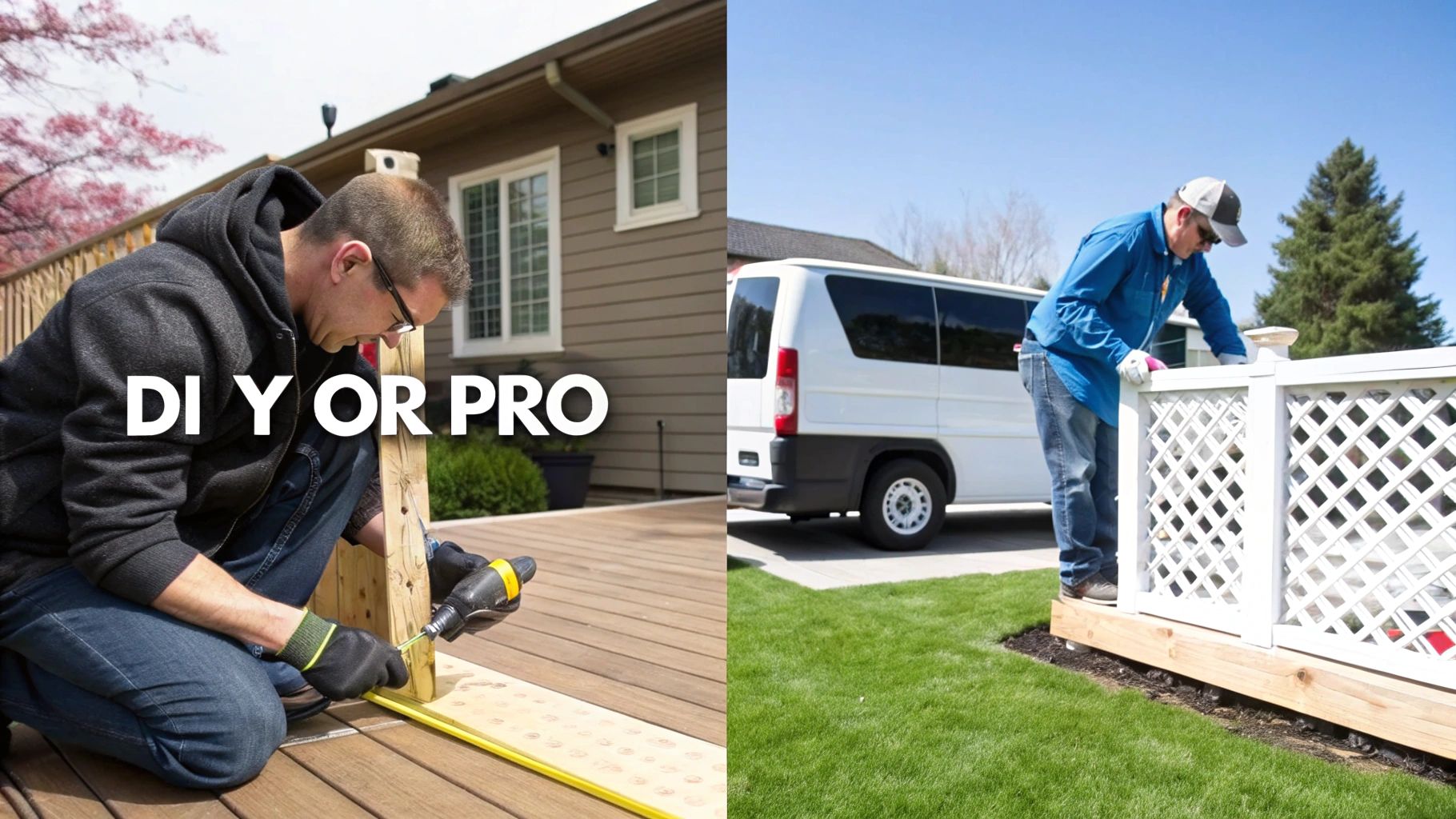
The allure of saving money is strong, no doubt. But that path demands a hefty investment of your own time, a lot of sweat, and often a surprising amount of money for specialized tools you might not have lying around in the garage.
The Realities of a DIY Deck Fence Project
Building a sturdy, straight privacy fence requires real precision, especially when you're attaching it to an elevated deck. The most critical task is setting the posts. They must be perfectly plumb—dead-straight vertically—and anchored securely. This ensures your fence won't start leaning after the first big windstorm or sag under its own weight.
Think of the posts as the foundation of a house. If they’re off, everything you build on top of them is compromised. This step alone often requires gear like a post-hole auger and a solid grasp of structural mechanics.
A professional installation is more than just labour; it's an investment in expertise, efficiency, and peace of mind. You're paying for guaranteed workmanship and the knowledge that your fence is built to last through many Canadian winters.
Hiring a seasoned contractor takes all the guesswork and stress off your plate. They arrive with a skilled crew, every necessary tool, and a deep knowledge of Ottawa-Gatineau's building codes and soil quirks. This ensures the project gets done fast and, more importantly, gets done right the first time.
A professional team can complete a project in a couple of days that might take a homeowner several weekends. They also handle sourcing all the materials and cleaning up the site, leaving you with nothing to do but pour a drink and enjoy your new private space. If you're leaning this way, our guide on what to consider when hiring Ottawa fence builders is a great place to start.
Making the Right Choice for You
To make your decision, run through this quick, honest checklist. Your answers will give you a clear idea of which path makes the most sense for you.
Your Skill Level: Have you tackled major woodworking or construction projects before?
Tool Access: Do you own or have easy access to a power auger, a good level, a mitre saw, and a nail gun?
Time Commitment: Can you block off several full weekends for everything from planning and shopping to building and cleaning up?
Physical Ability: Are you genuinely ready for the tough work of digging, hauling heavy lumber, and spending hours on precise measurements?
If you answered "no" to two or more of these, bringing in a professional is probably the smarter, safer, and less frustrating option in the long run.
Your Questions Answered
When you're planning a project like this, a lot of questions pop up. Here are some of the most common ones we hear from homeowners in the Ottawa-Gatineau area, with straightforward answers to help you move forward.
How High Can I Actually Build a Fence on My Deck?
This is a critical question because the rules can be tricky. In Ottawa, a standard backyard fence can go up to 2.1 metres (that’s 7 feet). But here's the crucial point: when you build that fence on top of a raised deck, the city measures the total height from the ground up.
Your best action is to check the local zoning by-laws yourself or, even better, work with a seasoned contractor. They’ll know the specific regulations inside and out and ensure your project is 100% compliant, saving you a major headache down the road.
What's the Easiest Deck Fence Material to Take Care Of?
If you’re looking for a "set it and forget it" option, PVC (vinyl) is the clear winner for our local climate. It's engineered to handle everything from humid summers to frigid winters without warping, cracking, or rotting like wood can.
You'll never have to paint or stain it. The only action needed is a simple wash with soap and water to keep it looking sharp for years. For homeowners who’d rather be enjoying their deck than working on it, it’s the perfect choice.
A solid-panel fence does more than just create privacy—it helps craft a peaceful environment. Its dense surface acts as a buffer, deflecting noise from busy streets or nearby neighbours. The result is a quieter, more relaxing retreat right in your own backyard.
Can a Privacy Fence Really Make My Deck Quieter?
Absolutely. A solid-panel privacy fence can make a noticeable difference. To reduce noise, think of it like a sound barrier. The continuous surface of materials like PVC or tongue-and-groove wood deflects sound waves away from your space.
This simple feature helps dial down the background buzz of the neighbourhood, making your deck a more comfortable spot for conversation or just unwinding in peace.
Will I Need a Permit for My Deck Fence in Ottawa?
For a straightforward backyard fence under 2.1 metres, you generally don’t need a permit in Ottawa. However, the game changes when you're building on an elevated deck, live on a corner lot, or have a pool.
Our advice is always the same: it's better to be safe than sorry. The most practical first step is a quick check with the City of Ottawa's building code services or a quick chat with your contractor before you start building to ensure everything is above board.
Ready to create that perfect private oasis on your deck? The expert team at FenceScape specializes in designing and building beautiful, durable privacy fences that are made to handle our Canadian seasons. Contact us today for a free, no-obligation estimate.
Comments